
Weekly Market Movers | October 5, 2026
10 minutes

Today on Weekly Market Movers:
- Tech Is Still Leading: The Nasdaq rose for a third straight week, while most other stocks struggled and small caps finished lower.
- Rates Keep Moving Higher: Long-term Treasury yields climbed to levels not seen in nearly 25 years, pushing borrowing costs higher across the economy.
- The Economy Is Still Growing: Manufacturing and services activity both remained strong, showing that businesses are still spending and hiring.
- Consumers Aren’t So Sure: Consumer sentiment remained weak, as many households continue to worry about inflation and the broader economy.
- Inflation Is Improving, But Not Enough: The Fed’s preferred inflation measure cooled, but inflation remains well above the Fed’s 2% target.
- Hiring Has Slowed: Job openings, payroll growth, and wage growth all softened, giving the Fed a little more room to pause on rates.
- Oil Remains a Wild Card: Oil prices eased during the week, but ongoing tensions in the Middle East continue to create uncertainty.
- AI Winners Keep Emerging: Strong results from Micron, Tesla, and Meta reinforced that demand tied to AI and technology remains strong.
- This Week Is About Inflation and Jobs: Investors will be watching the Fed minutes, inflation data, and employment reports for signs of where the economy and interest rates are headed next.
Chart of the Week
Transcript
Hello, and welcome to the Weekly Market Movers from Wealth Enhancement. My name is Aya Yoshioka, Director and Senior Investment Strategist.
Well, this past week, markets sent investors three very different signals. First, tech kept climbing, no surprise there, powered by AI, but the broader market struggled a little bit.
Second, the labor market cooled, but long-term interest rates moved higher on that news.
And third, the Fed may have some room to pause, even if inflation is not yet ready to cooperate, and we still need to wait for the last CPI report in the coming weeks.
Well, let’s get into what happened in markets this past week. And the punchline I mentioned earlier was that tech really held up.
Almost everything else had to fight the gravitational pull of higher yields. The S&P 500 slipped about 0.3%, the Dow fell 1.3%, and small caps lost roughly two-tenths of 1%.
The Nasdaq bucked the trend, gaining half a percent for a third straight weekly advance.
The message behind these numbers is important. AI leadership continues to remain a powerful source of market strength and remains pretty much in the driver’s seat here, but it is also doing a lot of the market’s heavy lifting.
The real action in markets, as always, came from the bond market. Treasury yields initially fell after Friday’s weaker-than-expected jobs report, then they snapped back by the end of the day as investors refocused on inflation pressures, oil, government borrowing, and a heavy supply of new debt.
The 10-year Treasury yield briefly approached 5.35%, a level not seen in 24 years, and ended Friday near 5.28%, while the 30-year finished Friday around 5.62%.
Now, what does this all mean? Well, a softer jobs report may have lowered the odds of an immediate Fed hike, but it did not calm the long end of the bond market.
And those yields don’t just stay on our trading screens. They flow directly into mortgages, corporate borrowing, acquisitions, and infrastructure, including the very large bill it is going to take to build out the infrastructure for AI, including all these data centers that we need.
High real yields also raise the bar for long-duration assets. In this environment, investors are rewarding visible cash flow and becoming less patient with stories on companies whose profits live too far out into the future.
Now, the economic data that we saw this past week offered something for both the optimists and the skeptics. Inflation improved, factories kept moving along and growing, but hiring lost some of its momentum.
So first, going to the good news, the Fed’s preferred inflation measure came in softer than expected. The Fed’s preferred inflation measure is the PCE, or Personal Consumption Expenditures Index. The August headline number saw a rise of 0.3% for the month and 3.4% from a year ago.
Core PCE, which excludes food and energy, increased 0.23% from a year ago. And that’s some progress, but still not mission accomplished relative to the Fed’s 2% target.
Now let’s go into the labor market.
Well, the labor market told a slightly different story.
We had several reports last week that continued to corroborate the low-hire, low-fire narrative of the labor market. First, we had the JOLTS report, and the JOLTS survey showed that job openings eased to 7.1 million in August, while hiring, quits, and layoffs barely moved. They were around 1%.
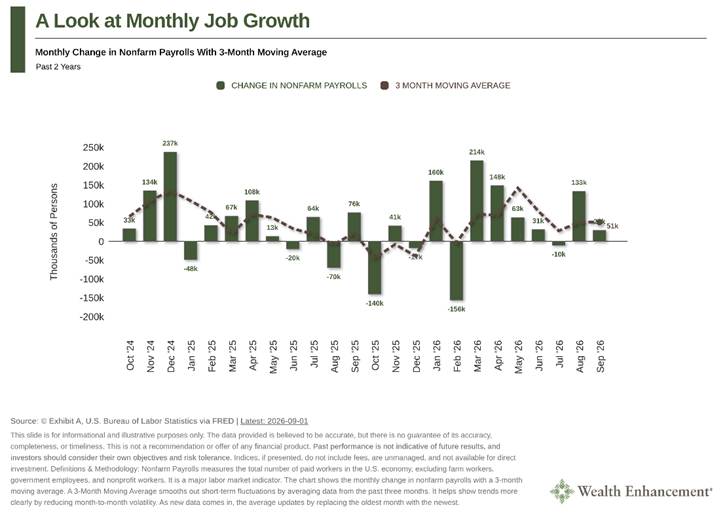
Then came Friday’s jobs report. As you can see from this chart, although it’s tough to see the most recent number, payrolls rose by 29,000 versus the 90,000 that was expected.
Unemployment ticked up to 4.2%, and the prior two months were revised down by a combined 60,000 jobs.
Wage growth also cooled, with average hourly earnings up only 0.1% for the month and 3.0% year over year.
So after this labor report, markets heard: maybe the Fed has less urgency for another October rate increase.
Slower hiring eases the wage pressure that can contribute to inflation, and it can also signal that the economy’s cushion is getting a little bit thinner.
Manufacturing offered a sturdier counterpoint. The September ISM Index held at 54.5, firmly in expansion territory.
New orders and employment improved, but prices jumped to 77.9.
That’s a little high. Growth is alive, but cost pressure is also alive.
Then there’s the energy story, the market’s wildcard. WTI crude ended Friday near $91 a barrel, and Brent was around $102. Prices eased as policymakers discussed coordinated reserve releases, especially in Europe, but geopolitics and tight supply kept volatility elevated.
Putting it all together, cooler jobs, resilient activity, and expensive energy give the Fed some room to potentially pause, but not enough evidence to take an inflation victory lap.
And we’ll get that CPI report on October 14.
Corporate results told a similar yet divided story. Micron delivered record fiscal fourth-quarter revenue and stronger guidance as demand for their high-bandwidth memory chips used in AI continued to outrun supply.
Micron closed out its fiscal year ending August 2026 with $133.2 billion in revenue, and that’s a 4x increase over 2025’s revenue of $37.4 billion.
Tesla also gained after third-quarter deliveries beat expectations.
Nike, on the other hand, moved the other way after warning of a steeper sales decline.
This paints a picture that the consumer is still spending, but not evenly and not without becoming a lot more selective.
Now, let’s look at the week ahead. The calendar is a little lighter, but the potential market catalysts are not.
Wednesday, we’ll get Fed minutes, and that’s probably this week’s main event. Policymakers raised rates by a quarter point in September to a range of 3.75% to 4%, and investors will look at those minutes for two things:
One, how united officials were when they made that decision, and two, what they were contemplating could trigger another move.
Thursday, we’ll get jobless claims to provide another real-time check after Friday’s payroll number. We’ll also get earnings from Pepsi, giving investors another read on pricing power and everyday consumer demand.
Friday closes out with consumer sentiment, as well as earnings from Delta Air Lines. Together, they will tell us more about household confidence, inflation expectations, travel demand, fares, and fuel costs.
And here’s the bottom line. The market will keep debating one big question: Is the economy cooling just enough to tame inflation, or cooling enough to threaten growth?
The U.S. economy is still expanding, but the leadership is narrow, and the margin for error, or the margin for disappointment, continues to shrink.
AI investment and manufacturing remain strong supports, but slower hiring and historically high long-term yields argue for greater selectivity and definitely not complacency.
For investors, this is a market to continue to participate in, but not to chase.
As always, we encourage you to stay diversified. We favor quality cash flows.
We maintain a stance of being valuation-aware, especially in equities. And in bonds, remember that starting yields matter, and currently you’re getting some pretty juicy yields. But keep an eye on your maturity exposure and inflation risk when it comes to fixed income.
That’s all I have this week. Thank you so much for watching. Have a great week.
This information is not intended as a recommendation. The opinions are subject to change at any time and no forecasts can be guaranteed. Investment decisions should always be made based on an investor’s specific circumstances. Investing involves risk, including possible loss of principal.
2026-14220
<a href=”/blog?keyword=&field_category%5B1886%5D=1886” class=”custom-taxonomy-link”>Investing</a>

Insights
Related resources for you
Get the latest wealth management tips and trends from our library of articles and resources.


