Weekly Market Movers | September 28, 2026
11 minutes

Today on Weekly Market Movers
- Big Tech Carried the Market: The S&P 500 and Nasdaq moved higher, but most stocks didn’t participate, with gains concentrated in large tech and AI names, including several Mag 7 companies.
- Rates Keep Climbing: Long-term Treasury yields rose to levels not seen in nearly 20 years, increasing borrowing costs across the economy.
- Businesses Are Still Spending: Manufacturing and services activity both strengthened, pointing to continued economic growth.
- Consumers Aren’t Feeling Great: Consumer confidence remained weak, even as housing activity showed some signs of improvement.
- Oil Cooled Off, For Now: U.S. oil prices fell during the week as investors reacted to signs of progress with Iran, though energy markets remain sensitive to geopolitical developments.
- AI Is Expanding Beyond Chatbots: Meta stock jumped after strong interest in its new AI assistant, showing how AI is starting to show up in more products and services.
- Inflation Is Back on the Calendar: This week’s PCE report could influence expectations for interest rates and what the Fed does next.
- Micron Could Set the Tone: The chipmaker’s earnings and outlook may provide another read on demand across the AI supply chain.
- The Big Picture: Economic growth remains solid and AI investment continues, but higher interest rates, inflation, and a market led by a relatively small group of stocks are creating a more challenging backdrop.
Chart of the Week
Transcript
Hello, and welcome to this edition of Weekly Market Movers from Wealth Enhancement. My name is Aya Yoshioka, Director and Senior Investment Strategist.
As always, we like to focus on three things in these videos. First, performance over the last week. Second, the economic, policy, and corporate news that drove this performance. And lastly, we will focus on what we’re watching this upcoming week as we close out the month of September.
Well, last week investors took in an unusual combination. Stocks actually advanced, especially with the help of large technology companies, while longer-term interest rates moved meaningfully higher.
We’ve seen correlations actually be more in line, and usually when yields go up, stocks do not tend to advance. But this past week, the S&P 500 gained about 1.2% for the week, the Nasdaq was up about 2.1%, and the Dow added about three-tenths of 1%.
Small-cap stocks, though, did not participate in this rally. The Russell 2000 declined roughly eight-tenths of 1%, and that split is important. The headline indices benefited from renewed enthusiasm for large technology companies and AI, as has been the theme, but the broader market faced continued pressure from the higher rates as investors viewed this through the lens of higher financing costs.
The week had begun with a strong rally in equities as oil prices and Treasury yields had retreated, but by the end of the week, the bond market’s message had changed.
The two-year Treasury yield ended the week near 4.81%, about five basis points higher for the week, and the 10-year Treasury yield rose 16 basis points to 5.2%. The 30-year yield increased about 15 basis points to 5.5%. These levels of long-term yields have not been seen in almost 20 years.
The MOVE Index, which measures volatility in the U.S. Treasury market, rose almost 30% by Thursday of last week.
These moves in the yields that we’re seeing affect far more than just bond portfolios.
Higher long-term rates raise borrowing costs for mortgages, corporate investment, acquisitions, infrastructure spending, including the cost of new construction to build the data centers needed for AI.
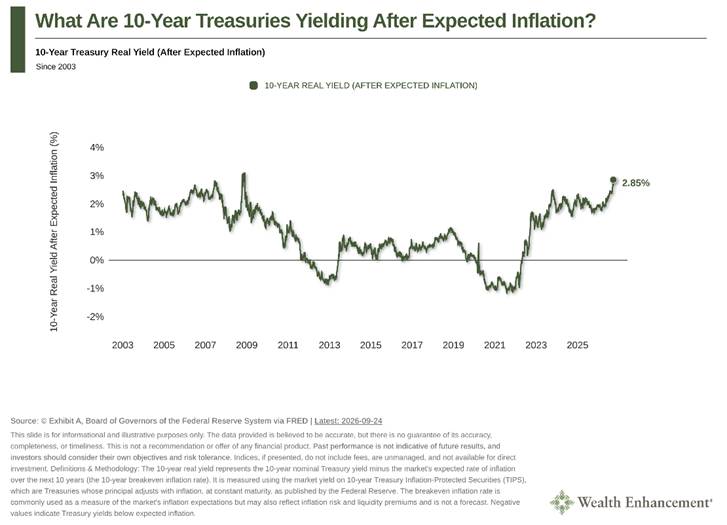
This chart here shows that the 10-year real yield, which is the 10-year yield minus the rate of expected inflation over the next 10 years, is at 2.85%, a level not seen since the early 2000s.
And why have yields risen? Well, in practical terms, investors are now assigning a wider range of possible outcomes related to future economic growth and future inflation, and there’s growing uncertainty surrounding the long-term trajectory of deficits and the U.S. debt burden.
And frankly, last week we saw some pretty good economic data.
Last week, we saw S&P Global’s preliminary September survey showed that both manufacturing and services expanded at a pretty strong pace. The manufacturing index rose to 57, up from last month’s 53.9, and the services activity index reached 58.7, up from last month’s 56.5.
Both indicated that business activity continues to expand and remain strong.
Businesses also reported faster selling price increases, reinforcing the concern that solid growth and persistent inflation are difficult to detangle.
While businesses continue to experience solid growth, consumer sentiment provided a different signal. The University of Michigan September reading remained very weak as households continue to express concern about inflation and the economic outlook.
To that regard, data was constructive but a little bit more mixed beneath the surface. New home sales increased to an annual rate of 684,000 in August, up 6.4% from July.
At the same time, sales were still 2% below last year’s level, and the median sales price was down nearly 6% from August 2025.
Energy markets offered some relief to consumers, although the geopolitical situation remains pretty unsettled. West Texas Intermediate crude ended Friday near $92 per barrel, down almost 8% for the week.
Investors really reacted to the possibility of a phased U.S.-Iran agreement and improved access through the Strait of Hormuz.
Brent crude was essentially flat for the week, as Brent remained above $100 per barrel. The difference between these two benchmarks is a reminder that the oil market is still reflecting regional supply constraints, shipping costs, and geopolitical risks, with changes from day to day.
A lower WTI price helps at the margin, but energy remains a potential source of volatility for inflation, consumer spending, and interest rates.
Corporate news also showed how strongly investors are rewarding visible growth. Meta gained 13% for the week, and all the buzz was around its Muse AI assistant.
Muse launched early in the month of September and has quickly risen to the top of the app stores. Muse allows users to create customized AI agents, agents that can go out and complete digital tasks for consumers or on consumers’ behalf, including things like cleaning up your inbox or canceling subscriptions. Perhaps you have duplicate subscriptions or subscriptions to things that you no longer use.
These developments expand the investment discussion beyond just AI chatbots or large language models, as well as the chips that make them, and investors contemplated how AI services may eventually impact corporate revenues in new ways.
Costco offered a read on the consumer. Quarterly net sales increased 11.2%, and full-year sales rose 10.1%. The results point to continued strength in value-oriented spending, although part of the earnings credit did come from tariff refunds. The stock ended the week up 3%.
Turning to the last week of September and the first couple of days of October, the focus really shifts back to inflation and employment.
On Tuesday, we’ll get the Job Openings and Labor Turnover Survey, which will show whether demand for workers remained firm or not in August.
The relationship among openings, hirings, and quits will be more informative than the headline number alone. A labor market can look stable because layoffs are low, even when businesses have become more cautious about adding workers.
Wednesday brings the Federal Reserve’s preferred inflation measure, the Personal Consumption Expenditures Price Index. Economists expect core prices to have risen about three-tenths of 1% in August, with the annual rate still in the mid-3% range.
A softer reading would reduce some pressure on bonds, and another firm reading would support the view that the Fed may need to keep policy restrictive for a little bit longer.
We will also receive the third estimate of second-quarter GDP on Wednesday, and because that report looks backward, any revisions to consumer spending, business investment, and corporate profits may matter more than the headline growth rate.
Micron reports on Wednesday after the close, and its results will provide a useful test of demand for high-bandwidth memory, which is used in AI systems, as well as pricing and the supply constraints around the AI supply chain.
With semiconductor shares contributing heavily to recent index gains, semiconductors were up about 6.3% last week. Micron’s forward guidance will carry a lot of weight in markets.
Thursday, we’ll get the ISM Manufacturing Report, which will help confirm whether the acceleration we’re seeing in the preliminary surveys from S&P Global is broad-based or not.
Investors will pay close attention to the new orders data, employment, and the prices-paid information in these surveys.
The week’s central event, though, arrives on Friday, October 2, as we’ll get the September employment report. August payrolls rose by 162,000, and the unemployment rate held steady at 4.1%. This time, the composition will be critical.
Private-sector hiring, wage growth, labor force participation, and revisions to prior months will help determine whether the labor market is generally strengthening or simply stabilizing after a softer summer.
For us, the takeaway is that equity markets continue to benefit from resilient economic activity and enthusiasm surrounding AI. At the same time, though, the rise in long-term Treasury yields, uneven market participation, and elevated inflation continue to create a more demanding environment for both stocks and bonds, keeping us very risk-aware and laser-focused on our process.
For portfolios, this argues for maintaining a focus on long-term objectives and proper diversification, which sounds boring, but we know it works. For stocks, technology leadership can continue, but higher yields can affect valuations and financing costs across the economy.
High-quality bonds now offer more income, but maturity exposure still matters, especially when inflation and monetary policy expectations move quickly.
With that, thank you so much for listening, and we hope you have a great week.
This information is not intended as a recommendation. The opinions are subject to change at any time and no forecasts can be guaranteed. Investment decisions should always be made based on an investor’s specific circumstances. Investing involves risk, including possible loss of principal.
2026-14124
<a href=”/blog?keyword=&field_category%5B1886%5D=1886” class=”custom-taxonomy-link”>Investing</a>

Insights
Related resources for you
Get the latest wealth management tips and trends from our library of articles and resources.