Weekly Market Movers | September 21, 2026
7 minutes

Today on Weekly Market Movers
- One Hike Down: The Federal Reserve raised interest rates for the first time since 2023, citing inflation that remains well above its 2% target.
- Markets Took It in Stride: Large U.S. stocks held up surprisingly well after the rate hike, while small caps and international stocks lagged behind.
- Higher Rates May Be Here to Stay: Most Fed officials expect at least one more rate hike this year, and markets are beginning to price in a longer period of elevated rates.
- Oil Remains a Wild Card: Oil prices stayed near recent highs as tensions in the Middle East continued, keeping inflation concerns alive.
- Past Hikes Act as a Reminder: History shows stocks can still move higher after rate hikes, but volatility often increases. Investors need to stick to their investment plan and avoid reacting to short-term market swings.
- The Economy Is Still Holding Up: Consumer spending, business investment, productivity, and hiring all remain relatively strong despite higher borrowing costs.
- Trump and Xi Meet This Week: Markets will be watching closely for signs of progress with China on trade, tariffs, technology restrictions, energy purchases, and agriculture.
- The Big Picture: Growth remains solid, but inflation, oil prices, and interest rates continue to shape the market’s outlook heading into the final months of the year.
Chart of the Week
Transcript
Hello, and welcome to the Weekly Market Movers. My name is Gary Quinzel with Wealth Enhancement.
The Federal Reserve delivered last week’s biggest headline, raising interest rates for the first time since 2023. That decision reshaped expectations for the path of rates, but the market response was more nuanced than the headline might suggest.
We’re going to break down why the Fed hiked, how markets reacted, and what the history of prior hiking cycles may tell us. Then we’re going to turn to iron ore and oil prices before looking ahead to this week’s marquee event, the Trump-Xi summit in Washington.
Last Wednesday, the Fed unanimously raised the federal funds rate by 25 basis points to 3.75% to 4%.
The basic reason was straightforward: inflation remains too high, and the Fed wants to bring it back toward 2% on a timelier basis. The Fed described economic activity as expanding at a solid pace. Consumer spending has remained resilient.
Capital investment has been robust, productivity growth has been strong, and job gains have broadly kept pace with growth in the labor force. That combination gives policymakers room to focus more directly on inflation.
Now, the complication is the energy shock associated with the Iran conflict.
Higher oil and fuel costs can lift headline inflation quickly, but they also work their way into transportation, production, and ultimately consumer prices. The updated projections reinforced that message.
Sixteen of 18 policymakers projected at least one more rate hike this year, and the median year-end estimate is now up to 4.1%. Fed futures markets moved even further, pricing a meaningful possibility of additional rate hikes into 2027.
For investors, the key takeaway is that the Fed is not simply restarting the old cycle on autopilot. Each decision will still depend on inflation data, growth, and, of course, labor market data.
But the burden of proof has shifted. Inflation now needs to cool convincingly before the market can become comfortable that this renewed tightening phase will be brief.
How did the markets react? Despite the hawkish shift, large-cap equities broadly held up.
The S&P 500 gained 0.42% for the week, leaving it up 0.32% for September and 12.46% year to date. The Nasdaq 100 led with a 1.78% gain and is now up 18.14% for the year.
Across other markets, the response was more nuanced. The Russell 2000 small-cap index fell 1.07%, while developed international stocks declined 0.79%.
Emerging markets gained 0.84%, although a stronger dollar remains a headwind.
The bond market delivered the clearest signal. The two-year Treasury yield rose 8.5 basis points to 4.75%, while the 10-year yield remained essentially flat at just under 5%.
This flattening of the yield curve reflects more expected near-term tightening without a comparable rise in long-term growth expectations.
The Bloomberg U.S. Aggregate Bond Index was nearly flat for the week but remains down 0.9% for September and 1.26% year to date. As mentioned, the dollar gained 0.84% last week.
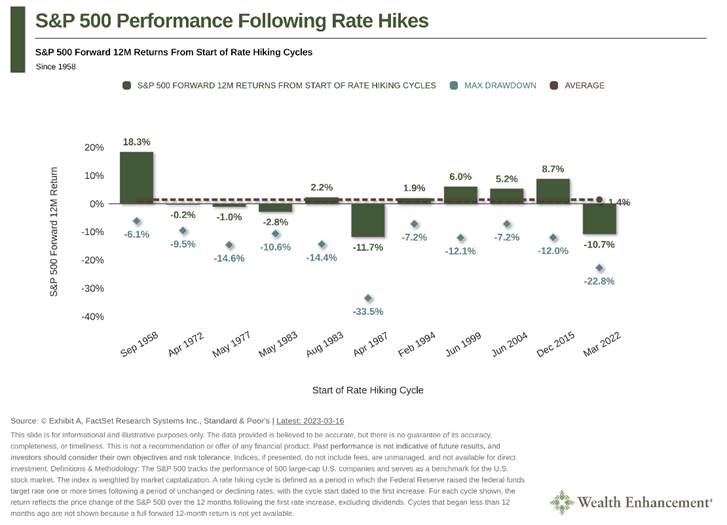
Now, I’m going to pull up a chart that shows some historical perspective. Across 11 hiking cycles since 1958, the S&P 500’s average return over the following 12 months was positive, but only by 1.4%.
Six periods produced gains and five periods produced losses, with outcomes ranging from an 18.3% advance to an 11.7% decline. The more consistent feature was volatility.
Every period experienced a drawdown ranging from roughly 6% to more than 33%. In the cycle that began in March 2022, the S&P 500 lost 10.7% over the following year and experienced a maximum drawdown of 22.8%.
Of course, this is not a forecast for what’s going to happen this time.
Today’s hike is a resumption of tightening rather than a perfect match for every historical starting point. But the lesson is useful. A hike does not automatically end in an equity advance, yet it raises the importance of earnings quality, valuation discipline, diversification, and, of course, staying invested through volatility.
The Iran war remains an important link between geopolitics, inflation, and monetary policy.
WTI crude fell 1.08% last week, but that modest decline needs context because oil was still up 11.17% in September and nearly 75% year to date. Gold also gained 1.84% for the week, even as the dollar strengthened, reflecting continued demand for safe-haven assets.
As long as Middle East supply routes remain at risk, oil can stay volatile and inflation pressures can remain elevated. Energy producers may continue to benefit, while airlines, transportation companies, manufacturers, and consumers face higher costs.
That makes the conflict not only a geopolitical story but also a central variable in the Fed’s next decision.
Now let’s turn to what’s going to happen this week. The week’s marquee event is the Trump-Xi summit.
Attention shifts to Trump’s meeting with President Xi in Washington. Expectations are relatively modest. The market’s base case appears to be an extension of the trade truce and a few tangible commitments rather than a comprehensive reset in U.S.-China relations.
A constructive outcome could include lower tariffs on selected non-sensitive goods, renewed Chinese purchases of U.S. agricultural products, perhaps a revival of U.S. LNG exports to China, and a framework for continued dialogue on AI.
That would be supportive for agriculture, LNG exporters, selected industrial companies, and Asian emerging markets.
A stronger upside surprise could be a broader tariff rollback or clear technology investment rules. This would, of course, benefit semiconductors, consumer electronics, autos, industrials, and global shipping by reducing supply chain uncertainty.
The downside scenario is a summit that ends with little progress or renewed confrontation.
The hardest issues remain AI and semiconductor controls, China’s industrial capacity, and Taiwan. If talks disappoint, semiconductors and AI hardware will likely be the first pressure points, followed by consumer electronics, solar, autos, and Asian EM currencies.
U.S. farmers and LNG exporters could also lose if promised purchases fail to materialize.
The most likely result, as always, is somewhere in the middle: enough progress to preserve the truce, but not enough to resolve the strategic competition.
For markets, the details will matter more than the photo op, especially any language on tariffs, technology restrictions, energy purchases, and agriculture.
That’s it for this week’s Weekly Market Movers. We’re going to be watching incoming inflation data, the path of oil prices, and, of course, the outcome of the Trump-Xi summit.
Thanks for joining us, and tune in next week. Take care.
This information is not intended as a recommendation. The opinions are subject to change at any time and no forecasts can be guaranteed. Investment decisions should always be made based on an investor’s specific circumstances. Investing involves risk, including possible loss of principal.
2026-14057
<a href=”/blog?keyword=&field_category%5B1886%5D=1886” class=”custom-taxonomy-link”>Investing</a>

Insights
Related resources for you
Get the latest wealth management tips and trends from our library of articles and resources.