Weekly Market Movers | September 14, 2026
9 minutes

Today on Weekly Market Movers
- Oil Drove the Week (and Prices): Oil prices jumped above $100 per barrel again as tensions in Iran and around key shipping routes intensified, fueling inflation concerns.
- Inflation Heated Back Up: Consumer and producer prices both came in higher than expected, making it harder for the Fed to declare victory over inflation.
- Rate Hike Expectations Surged: Markets went from expecting the Fed to hold rates steady to almost fully pricing in a rate increase at this week’s meeting.
- Bond Yields Moved Higher: Treasury yields climbed sharply as investors demanded more compensation to lend money in an environment of higher inflation and government borrowing.
- AI Spending Faces Further Scrutiny: Demand for AI infrastructure remains strong, but investors are becoming more selective about which companies can turn that spending into profits and cash flow.
- Energy Risks Aren’t Going Away: New attacks on Saudi oil infrastructure over the weekend pushed oil prices even higher and added another layer of uncertainty heading into the week.
- Big Week for Central Banks: The Fed, Bank of England, and Bank of Japan all meet this week, and investors will be watching closely for signals on interest rates and inflation.
- The Big Picture: Economic growth remains solid and AI investment continues, but higher oil prices, persistent inflation, and rising interest rates are rightfully making markets more cautious.
Chart of the Week
Transcript
Good morning, and welcome to Wealth Enhancement’s Weekly Market Movers video series. My name is Doug Huber, and I’m the Deputy Chief Investment Officer. I hope everyone’s week is off to a great start, and I look forward to getting into what drove market price action last week and what we’re looking for in the markets and the economy this week.
Last week’s story was really about the interaction among oil prices, inflation, and interest rates.
This week is certainly going to add important new questions about artificial intelligence, which we’ll touch on in a little bit.
For the week, equity markets had a bit of a difficult run. The S&P 500 declined by eight-tenths of one percent, or 0.8%. The tech-heavy Nasdaq lost about the same. I think it was down about 0.7%, or seven-tenths of one percent. The Dow fell 1.6%. Small caps declined by 2.4%, and even the equal-weighted version of the S&P 500 was down 2%.
That’s really suggesting that the weakness was broader than the headline S&P 500 performance showed.
For the week, energy was the leading sector overall, as oil prices certainly had a sharp upward move, while healthcare and materials lagged.
Oil was really the clearest cross-asset-class driver.
WTI, or West Texas Intermediate, gained more than 9% to finish the week above $100. Brent, the more international measure, also rose about 9% to finish above $105. These increases are reflecting escalating conflicts in Iran and around the Strait of Hormuz, Saudi infrastructure, and Red Sea shipping.
We should keep the facts and the interpretation separate, though. Markets are clearly assigning a larger and longer supply-chain risk premium, but it’s important to understand that, in real time, the data we have is not proving that we’re losing physical supply at the same rate prices are increasing. The market is really telling us, “Hey, we think this supply constraint is going to be here to stay for the foreseeable future, and we don’t see an end in sight for this conflict and a freeing up of those shipping channels.”
Those higher energy costs have really fed into an already difficult inflation picture.
Headline consumer prices rose 0.4% in August and were up 3.4% year over year. Core inflation also came in a little firmer than expected, as shelter, airfares, lodging, and communications all increased.
Producer prices also rose 0.4%, bringing annual wholesale inflation to 5.4%. Those reports really changed expectations for Federal Reserve policy, and you could see it in what happened with bond yields.
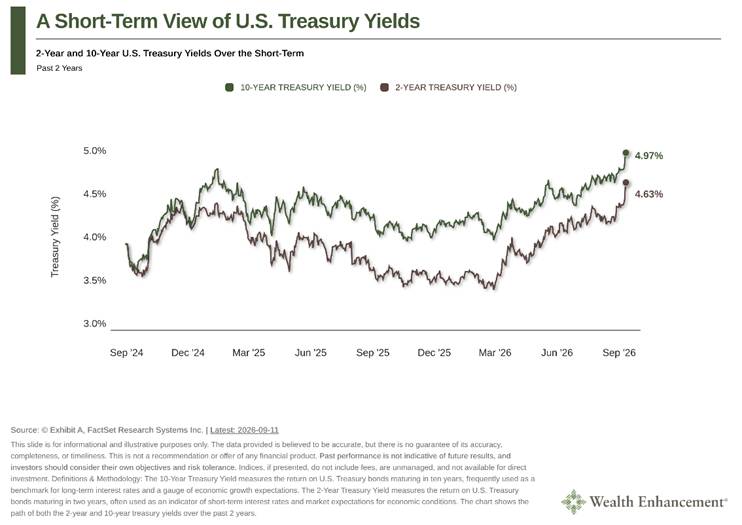
I’m going to share a quick chart here while I go through it.
At the start of last week, many economists were expecting that the Fed was going to leave interest rates unchanged when they meet on Wednesday. But after Friday’s inflation report, the market is now at something like a 92% to 97% expectation that they will raise rates by a quarter point this Wednesday.
The Treasury market has already clearly adjusted for that sharply, and you can see how quickly both the two-year and 10-year yields moved up in this chart.
The two-year yield rose about 25 basis points to 4.63%. The 10-year finished near 4.97%, and the 30-year, which you can’t see on this chart, was at about 5.34%.
What you saw was short-term yields rising more than long-term yields, producing a flatter curve. This is really consistent with markets pricing in greater near-term restraint from the Fed. The Fed controls the front end of the curve, where they set policy. The back end moves with term-premium expectations.
Most of the increase you see in the 10-year yield came through real yields and term premium, meaning investors are demanding more inflation-adjusted compensation to hold longer bonds.
Treasury auctions remained strong, which is showing us that inflation, policy, and fiscal term premium are really the more credible explanations than a generalized refusal to buy government debt.
It’s saying, “Hey, as an investor, you’re going to need to pay me more at the back end of this curve because I don’t think you have your fiscal and monetary house in order. There’s competing supply coming from investment-grade bonds, and there’s just a little bit more going on. That’s why you have to give me more money to buy these bonds.”
On the flip side, corporate credit was comparatively very calm.
Investment-grade spreads tightened slightly, high-yield spreads widened slightly, and municipal bonds had a bit of a tough week. At the same time, higher rates coincided with a pretty heavy new-issue calendar last week.
On the equity side, performance was highly dispersed.
Several healthcare companies fell after clinical trial disappointments. I think we had Novartis and Amgen weighing on the Dow.
Tech was more resilient.
You had Oracle, which had been beaten up in this AI cycle as they were the poster child for spending a lot of money out of the gate. Well, it showed up. Oracle reported 121% cloud infrastructure growth.
The market initially responded positively to that, but it gave up those gains as investors focused more on capital needs, customer concentration, and converting all of this spending into free-cash-flow generation.
We did have a couple of bright spots at the end of the week.
Hewlett Packard and Dell each rose about 12% as investors revisited demand for AI servers and networking, where they are major suppliers.
This contrast is a useful reminder for us. AI demand can be very strong at the same time investors become more selective about valuation, financing, margins, and customer concentration.
This week is going to be a big one for AI discussion. The conversation shifted materially over the weekend as prominent industry leaders from ChatGPT to Claude to Grok all came out in favor of stronger controls and more coordination around advanced systems.
Overnight, AI-linked shares fell sharply in Asia, and this morning we’re seeing weakness in U.S. technology futures.
These statements are important, but they are not a binding investment pause.
The key question is whether they change chip orders, data-center construction, or product deployment. Until then, today’s move is more of a repricing of expectations and probably a knee-jerk reaction to a very powerful headline: the leaders of this AI movement are coming back and saying, “Hey, we might need to rein this in until we have a full understanding of the power and capabilities these technologies provide.”
Energy risk also intensified over the weekend.
Saudi Arabia’s East-West Pipeline, which is really their alternative route to the Strait of Hormuz, was closed after drone attacks severely damaged the pipeline. That is causing oil to move higher again this morning.
The repair timeline and amount of displaced exports remain uncertain, but we’ll have to wait and see if this is something that can be resolved quickly or if it becomes a more prolonged outage, which would put further pressure on transportation costs, consumer budgets, and inflation expectations. The flywheel goes on.
This week’s Fed meeting on Wednesday is the central event.
A quarter-percentage-point increase is widely expected, so the vote projections and Chair Kevin Warsh’s press conference may matter more than the rate change itself. That’s pretty much priced in at this point.
Investors are going to want to know whether this is a limited response or the beginning of a longer tightening cycle.
Retail sales data arrives Wednesday morning and will provide an important read on household demand.
Housing starts, permits, and pending sales are coming on Thursday. We’re also going to see Lennar, a major homebuilder, report earnings, which will add some real-time information about the housing sector.
Global policy also comes into play this week.
The Bank of England also has a meeting on Thursday and is expected to hold rates steady, but it will be interesting to see whether oil prices have increased the risk of a surprise.
The Bank of Japan, or BOJ, is expected to raise rates on Friday.
We have all of these central banks meeting this week, and it will be really interesting to see what their policy decisions are against the backdrop of higher energy costs and what the implications are for their domestic markets.
The balanced takeaway here is that neither equities nor credit are signaling an imminent market or economic collapse.
Growth remains resilient in most of the important areas, and AI infrastructure demand remains strong. However, there are going to be a lot of headlines. At the same time, we are seeing inflation risk increase, oil supply become less certain, and long-term financing costs remain high.
The question is: what impact does that have on the market?
All of this is trying to be priced in this week.
There are a lot of events ahead, and we look forward to coming back to you next week with a readout on what we heard from all of the different central banks and, hopefully, more color around oil prices and inflation data.
We thank you for tuning in this week and look forward to chatting with you again.
This information is not intended as a recommendation. The opinions are subject to change at any time and no forecasts can be guaranteed. Investment decisions should always be made based on an investor’s specific circumstances. Investing involves risk, including possible loss of principal.
2026-13955
<a href=”/blog?keyword=&field_category%5B1886%5D=1886” class=”custom-taxonomy-link”>Investing</a>

Insights
Related resources for you
Get the latest wealth management tips and trends from our library of articles and resources.