
Weekly Market Movers | August 10, 2026
8 minutes

Today on Weekly Market Movers
- Markets Regain Momentum: Solid economic data, healthy earnings growth, and fading concerns about additional Fed rate hikes helped drive a broad-based market rally.
- AI Continues to Lead: Technology stocks outperformed as investors continued to favor companies positioned to benefit from ongoing AI investment and infrastructure spending.
- Earnings Remain a Bright Spot: Corporate profits continued to support markets, with earnings growth running at its strongest pace in several years.
- Oil Adds Uncertainty: Continued tensions involving Iran fueled volatility in oil prices, keeping energy markets and potential inflation pressures in focus.
- Job Growth Shows Signs of Cooling: A softer-than-expected employment report raised concerns about slowing labor demand, while easing expectations for additional Fed tightening.
- Inflation Moves Into Focus: Attention now turns to this week’s CPI report, which could provide important clues about the direction of inflation and the Fed’s next policy move.
Watch the full video
Chart of the Week
Transcript
Hi, and welcome to Weekly Market Movers. My name is Gary Quinzel with Wealth Enhancement.
Last week was a strong one for risky assets as the S&P 500 posted its best weekly gain since April. But beneath the headline performance, markets were balancing three very different forces. One, a strong fundamental backdrop continues to support equities. Meanwhile, ongoing political uncertainty in the Middle East is creating volatility. And lastly, a surprisingly weak U.S. jobs report changed the conversation around the Fed’s next move.
Let’s start with equities.
The S&P 500 finished the week higher, with most of those gains front-loaded on Monday. The index rose nearly 1.8% that day following a very strong ISM manufacturing report before consolidating through the middle of the week and then getting another boost Friday after that employment report.
Meanwhile, the Nasdaq 100, which is tech-heavy, was a standout among the major U.S. indices, gaining around 3.3% for the week. Technology continues to be one of the primary drivers of this bull market, supported by enthusiasm around the AI investment supercycle, as well as declining expectations for additional Fed tightening.
International developed markets also participated, as the MSCI EAFE Index, representing developed markets, gained roughly 1.7%, while emerging markets lagged with a gain of less than 0.5%.
Turning to fixed income, bonds benefited from the softer labor market data that I talked about. The U.S. Aggregate Bond Index gained about 0.4%, while the 10-year Treasury finished the week around 4.63%, which is very important because Treasury yields had risen roughly 33 basis points during the prior five weeks as investors had become increasingly concerned about the possibility of another Fed rate hike.
Now, following the jobs report, those expectations have eased considerably. Markets now appear to be pricing in no additional hikes before December. Of course, that can and will change.
So let’s talk a little bit about what drove markets last week. I’m going to break it down into three themes.
The first is the continued strength of corporate earnings, as well as the broader economic backdrop.
Second-quarter earnings season is now roughly 90% complete, and earnings growth is tracking at roughly 50% year over year, which would be the strongest pace since the second quarter of 2021. Now, it should be noted that Alphabet and Amazon, two of the hyperscalers, account for a meaningful portion of that growth. But even excluding those two companies, earnings are still growing at approximately 32%.
Perhaps even more encouraging, all 11 sectors are reporting earnings above expectations, while revenue growth is tracking nearly 15%, which is also the strongest pace we’ve seen in several years.
That strength in corporate fundamentals was reinforced last week by the July ISM Manufacturing PMI report. That index rose to 55.6, its highest level since May 2022, marking the seventh consecutive month of expansion. Any number over 50 indicates that the industry is expanding.
If you break it down a little bit, you’ll note that new orders and production both accelerated at a faster pace, and employment within the manufacturing sector finally started to show some signs of life. So, a lot of good indicators within the manufacturing sector.
Despite persistent concerns around interest rates and geopolitics, the underlying picture remains one of solid economic activity and very strong corporate profitability.
Let’s talk now about the second major theme, which is Iran, oil prices, and the inflation outlook.
The back-and-forth, as we all know, between the United States and Iran continues, with repeated reports of potential progress but little evidence of a lasting resolution. Oil prices have been extremely sensitive to those headlines.
WTI crude traded as high as roughly $92 a barrel in late July before falling toward $75 a barrel last week, as optimism increased around a potential Hormuz agreement. But by the end of last week, prices had recovered somewhat, and now oil is back above $80 per barrel.
That volatility, of course, matters well beyond the energy sector. Higher oil prices will filter into transportation costs, consumer prices, corporate margins, and, ultimately, inflation expectations.
And now that earnings season is largely behind us, geopolitics, and specifically Iran’s impact on energy prices, could once again become one of the primary market drivers.
Also worth noting, gold had an extraordinary week last week, rising more than 7% to finish near $4,342 an ounce, which is one of the larger weekly moves. But despite that significant move, gold still remains roughly 20% below its January peak.
The rally did reflect a combination of dollar weakness, geopolitical uncertainty, as well as continued demand for safe-haven assets.
Let’s now dive into the third major theme, which arguably might be the most important one, at least for the Fed, and that was Friday’s softer-than-expected jobs report.
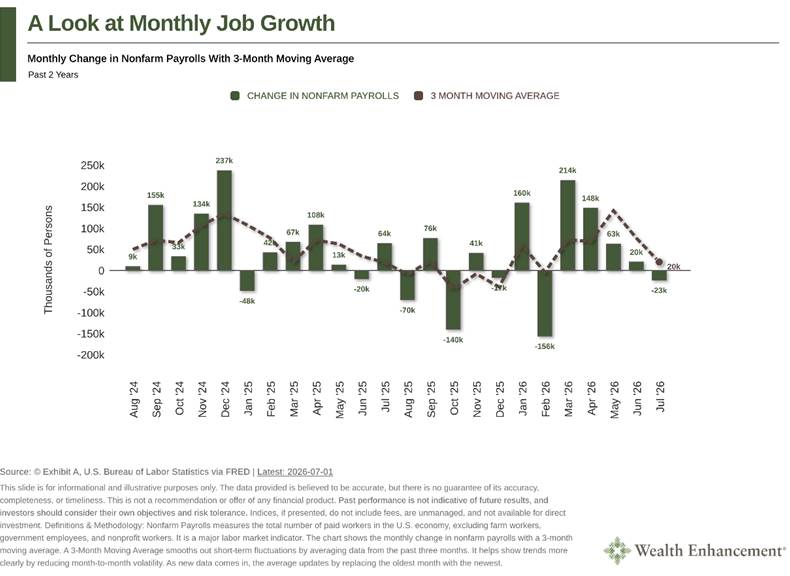
As I noted, the employment report missed across nearly every major metric. The U.S. economy lost 23,000 jobs in July versus expectations for a gain of roughly 80,000 jobs. That’s a miss of over 100,000 jobs and marked the first monthly contraction in payrolls since February.
Previous months were also revised lower by roughly 74,000 jobs, while the labor force participation rate declined for the third consecutive month. Those numbers clearly point toward some cooling in the labor market.
On that note, I’m going to quickly pull up a chart here to share what I’m talking about.
What you can see in this chart is that the monthly change in nonfarm payrolls, with the three-month moving average, has been on a steady decline since March, going from 214,000 jobs all the way down to minus 23,000 jobs as of July.
This is potentially meaningful. It certainly has some disinflationary impacts, especially when you take a look at what the Fed is watching. They not only look at the headline number, but they’re also looking at average hourly earnings.
Average hourly earnings slowed to roughly 3.2% year over year, down from 3.5% previously, as well as below expectations. That is a potentially meaningful disinflationary signal because wage growth feeds directly into the cost of providing services.
And that brings us to what markets will be watching this week, which is the July CPI report.
The stakes are unusually high following Friday’s employment data. If inflation comes in softer than expected, it could effectively close the door on a September Fed rate hike. But if CPI surprises to the upside, the debate could quickly reopen despite the weakness we just saw in the labor market.
There are a few areas that are worth watching very closely.
The first is shelter inflation, which remains the largest contributor to above-average inflation. Any meaningful slowdown there would certainly be important.
The second is what the Fed often refers to as core services excluding shelter, a.k.a. “supercore” inflation. That measure matters because it captures service-sector inflation that is particularly sensitive to labor costs.
In that sense, Friday’s cooling labor data is somewhat encouraging because it will not incentivize the Fed to raise rates anytime soon. But, of course, we still have the volatility of oil out there, which remains a wild card. Even if underlying inflation continues to moderate, another sharp increase in energy prices stemming from the Middle East could, of course, complicate the Fed’s job.
So, putting everything together, markets are currently balancing an unusually strong corporate earnings environment against two very significant macro risks: geopolitical pressure on energy prices, as well as a labor market that suddenly appears to be losing some momentum.
But for now, equities continue to benefit from strong earnings and the AI investment cycle, while bonds are getting some relief from reduced expectations for Fed tightening.
As I mentioned, the next major test comes with CPI. That’s what we’re going to be watching this week.
We hope you found today’s update informative, and as always, if you have any questions, please reach out to your financial advisor.
Thanks again for joining me, and we’ll see you next week. Take care.
This information is not intended as a recommendation. The opinions are subject to change at any time and no forecasts can be guaranteed. Investment decisions should always be made based on an investor’s specific circumstances. Investing involves risk, including possible loss of principal.
2026-13551
<a href=”/blog?keyword=&field_category%5B1886%5D=1886” class=”custom-taxonomy-link”>Investing</a>

Insights
Related resources for you
Get the latest wealth management tips and trends from our library of articles and resources.


