
Weekly Market Movers | September 8, 2028
9 minutes

Today on Weekly Market Movers
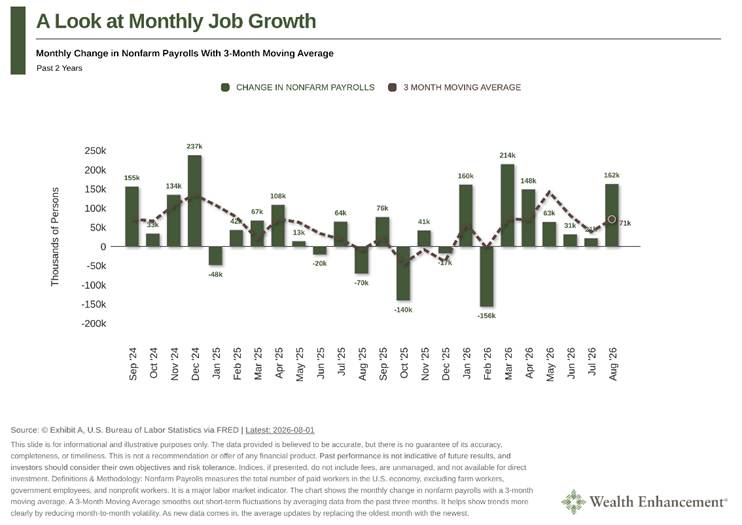
- The Economy Looks Strong: The U.S. added 162,000 jobs in August, far more than expected, and unemployment stayed low, reinforcing that the economy is on solid footing heading into September.
- Most Stocks Were Down: The major indexes were mostly flat, but more than half of stocks actually finished the first week lower.
- Interest Rates Moved Up: Strong economic data pushed Treasury yields higher and lowered expectations for Fed rate cuts.
- Oil Prices Rose: New tensions involving Iran sent oil prices higher, adding to inflation concerns.
- Strong Results Weren’t Always Rewarded: Some companies reported excellent earnings but still saw their stocks fall because investors had set the bar extremely high and expected more.
- Big Names Report This Week: Oracle, Adobe, and Apple could provide a clearer picture of business spending, AI adoption, and consumer demand.
- Now We Wait for the Inflation Data: This coming Friday’s CPI report could play a big role in determining whether the Fed stays patient or considers raising rates.
Chart of the Week
TRANSCRIPT
Hello, my name is Aya Yoshioka, Director and Senior Investment Strategist at Wealth Enhancement. Welcome to this week’s Weekly Market Movers video. We hope you had a great Labor Day weekend.
In this video, we will focus on three things. First, we’ll talk about market performance. Second, we’ll discuss the news that drove this market performance. And lastly, we’ll walk through what we’re watching for this week.
Last week gave investors stronger evidence that the U.S. economy remains very resilient, but it also made the interest rate outlook more complicated.
The S&P 500 finished almost exactly flat, while the Nasdaq gained about four-tenths of one percent. Those headline results did not fully reflect what happened beneath the surface. The equal-weighted S&P 500 declined approximately eight-tenths of one percent, value stocks outperformed growth stocks, and fewer than half the companies in Morningstar’s U.S. market universe advanced.
Energy and technology stocks were the strongest sectors, while consumer discretionary stocks were among the weakest.
Now let’s go into one of the charts we have for this week.
The most consequential economic news arrived on Friday. The economy added 162,000 jobs in August, nearly three times what the consensus was expecting.
The unemployment rate remained at 4.1%, and prior months were revised higher.
Services activity also strengthened, manufacturing remained in expansion, and weekly unemployment claims stayed low.
Taken altogether, these reports reduced concerns that the economy is moving toward any kind of recession. They also gave the Federal Reserve less reason to overlook inflation that remains above its 2% target.
On Thursday, Federal Reserve Governor Christopher Waller said he could support leaving rates unchanged if inflation continued to improve.
Stocks rallied, Treasury yields declined, and investors reduced expectations for a September rate increase. But Friday’s unemployment report reversed much of this reaction. The two-year Treasury yield briefly moved above 4.4%, the dollar strengthened, and the two-year, 10-year, and 30-year Treasury yields ultimately rose about four basis points on the week, with the two-year finishing around 4.38%, the 10-year at 4.77%, and the 30-year at 5.25%.
Corporate credit spreads widened modestly but remained contained. The VIX was also near 14.5% at the end of the week.
These indicators suggest that investors are repricing interest rates and company-specific risks, not preparing for broad corporate distress.
Turning to energy, energy created an additional complication. West Texas Intermediate crude gained about 10% last week, while Brent rose nearly 8%.
Over the weekend, U.S. and Iranian forces exchanged further attacks involving tankers and naval targets.
Iran then announced that it intends to create an exclusion zone near the Strait of Hormuz.
Oil is trading in the mid-to-upper 90s range this morning, and it’s important to distinguish what is confirmed from what remains uncertain. Military activity has escalated, shipping traffic has declined, and the oil market is assigning a higher risk premium. However, Iran has not yet published all the details of its proposed exclusion zone, and available data do not establish the full amount of physical oil supply that has been lost.
Oil matters well beyond the energy sector.
It affects gasoline, transportation costs, consumer confidence, inflation expectations, and ultimately central bank policy.
Now turning to corporate earnings, corporate earnings provided another useful lesson about expectations. Dell reported record revenue and raised its outlook for AI-related servers.
Broadcom had a great quarter, and its AI semiconductor revenue more than tripled, but its stock declined because forward guidance did not meet an unusually demanding set of expectations, at least the guidance for the coming quarter.
That contrast reinforces two points. First, AI infrastructure demand remains very strong. Second, extraordinary growth does not guarantee a positive stock response when valuations and expectations are already elevated.
The same theme will remain important this week. We have Oracle reporting on Thursday, and this will provide a read on overall cloud demand, AI bookings, data center investment, and financing requirements. Oracle is especially relevant because the AI investment cycle now extends well beyond semiconductor stocks.
It affects corporate borrowing, utility demand, construction, private market investment, and the competition for capital that also influences Treasury yields.
Adobe also reports on Thursday, and investors will focus on whether AI tools are producing new subscription and usage revenue rather than simply adding development costs or creating new competitors.
Apple holds its product event on Wednesday.
Pricing, availability, and the usefulness of its AI features will matter more for the investment discussion than cosmetic product changes.
However, the week’s big central event will be Friday’s Consumer Price Index report.
Economists expect headline inflation to remain near 3.4% for the year, while core inflation, excluding food and energy, may ease to approximately 2.4%.
The monthly core increase is expected to be around two-tenths of one percent.
A contained core reading, particularly in shelter and services, would support the argument that the Fed can remain relatively patient despite strong employment. A broader increase of three-tenths of one percent or more would likely strengthen the case for a rate increase at the September meeting.
Producer inflation arrives on Thursday and could provide an early indication of pricing pressure. We will also receive existing home sales and preliminary consumer sentiment information.
Outside the U.S., the ECB, or the European Central Bank, is expected to raise its deposit rate by a quarter percentage point. Because that increase is already anticipated, the market response will depend on whether officials describe it as sufficient or leave the door open to additional tightening.
The Treasury will also auction three-, 10-, and 30-year securities. Demand for the longer maturities will be important because rising borrowing requirements, corporate issuance, and AI-related financing are all competing for investor capital.
Finally, Canada’s retaliatory tariffs on selected U.S. goods are scheduled to take effect on Thursday.
Their immediate broad market impact may be modest, but they add another layer of costs and planning uncertainty for affected businesses.
The balanced takeaway is that U.S. growth appears more resilient, corporate credit remains orderly, and AI investment continues to expand.
At the same time, inflation is still above target, oil is again a material risk at these price levels, and market participation remains narrower than the index headlines currently suggest.
For portfolios, this argues for discipline rather than reacting to every daily reversal. Diversification across sectors, investment styles, regions, and bond maturities remains important, especially when the AI, energy, and interest rate narratives increasingly overlap across what may otherwise appear to be separate investments.
Thank you for listening and watching, and we hope you have a great week.
This information is not intended as a recommendation. The opinions are subject to change at any time and no forecasts can be guaranteed. Investment decisions should always be made based on an investor’s specific circumstances. Investing involves risk, including possible loss of principal.
2026-13883
<a href=”/blog?keyword=&field_category%5B1886%5D=1886” class=”custom-taxonomy-link”>Investing</a>

Insights
Related resources for you
Get the latest wealth management tips and trends from our library of articles and resources.


