
Weekly Market Movers | August 24, 2026
8 minutes
Today on Weekly Market Movers:
- Rates Hurt Stocks: Rising Treasury yields were the biggest force in markets, putting pressure on stocks, especially tech.
- AI Still Needs to Deliver: Investors still believe in AI, but they’re looking for proof that all the spending will turn into real growth and profits. NVIDIA’s earnings this week could provide some answers.
- Consumers are Feeling the Squeeze: Retail sales slowed, suggesting higher prices may be starting to affect spending habits.
- Oil is Back in Focus: Rising oil prices and ongoing uncertainty around Iran put inflation back in the spotlight.
- Win for Healthcare: A breakthrough cancer treatment from Moderna and Merck was a reminder that innovation isn’t just happening in tech.
- All Eyes on the Fed’s Next Move: Investors will be listening for clues at the Jackson Hole conference. How is the Fed is thinking about inflation, interest rates, and the economy?
Watch the full video:
Chart of the week:
Transcript:
Hello and welcome to this edition of Weekly Market Movers from Wealth Enhancement. My name is Aya Yoshioka, Director and Senior Investment Strategist. In this video, we will talk about three things. First, performance over this past week. Second, news that drove this performance. And lastly, we will look out into what we are watching for this week.
Well, let’s start with the market returns for the week ending August 21.
Stocks managed to bounce on Friday, but it was not enough to erase the losses that we’d seen earlier in the week. The S&P 500 index finished the week down 1.4%. The NASDAQ composite declined roughly 2% and small cap stocks represented by the Russell 2000 Index were down 1.7%. The common thread across markets was the move higher in interest rates or treasury yields, which pressured longer duration growth stocks and kept investors focused on the overall cost of capital.
Gold was up 5% on the week. Crude oil was up 2.5% with Brent crude at $94 or around $94 per barrel and the US dollar weakened by 1%.
Now, even with this pullback in equities, the broader market tone isn’t decisively negative. Risk appetite is still there, but it has become more selective.
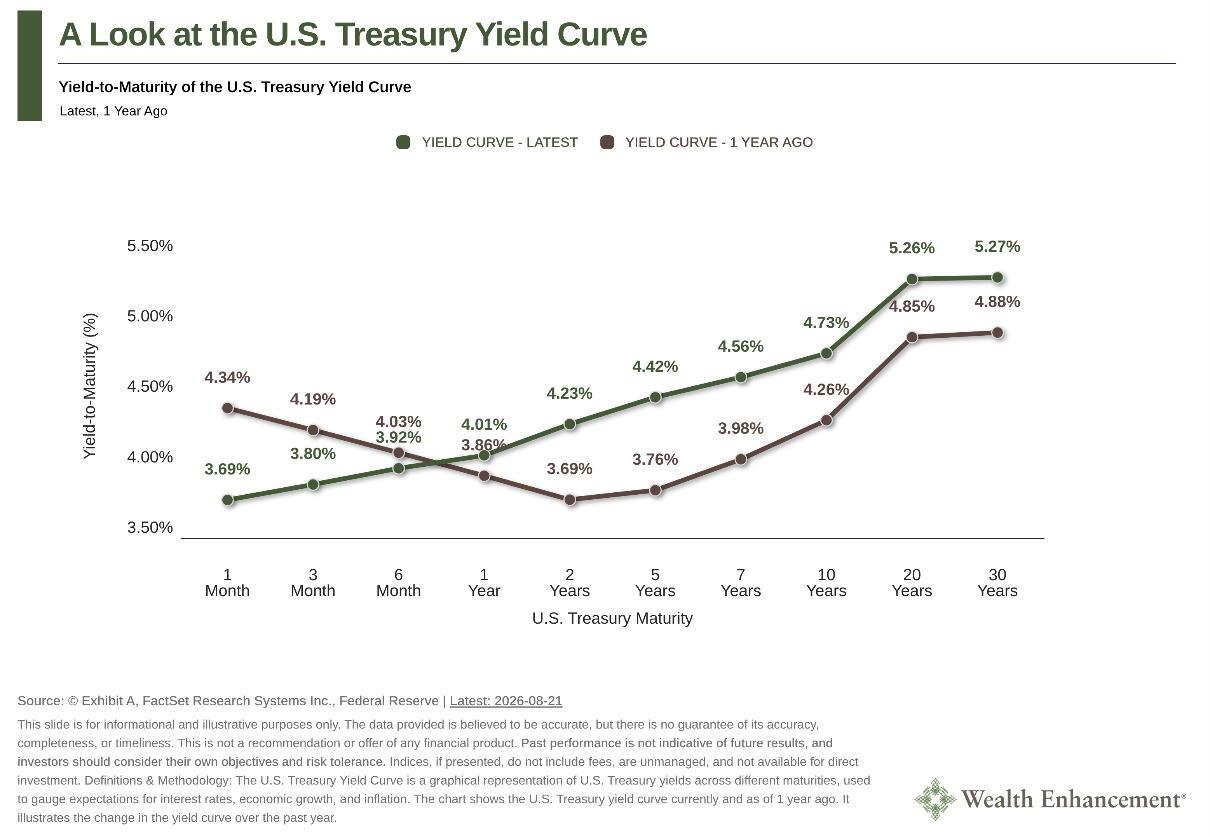
Well, there has been lots of news in fixed income markets. So, I thought we would look at treasury yields.
The 10-year treasury yield ended the week near 4.7% and the 30-year treasury yield touched 5.3% hitting a 19 year high. You can see from the chart that shows where yields were a year ago and where they are now, that the rise in rates has really been on the longer end of the curve. We showed this chart because the level of treasury yields continues to matter for markets, as it impacts everything from equity valuations, the multiples we pay for stocks, mortgage rates, corporate financing costs and overall investor sentiment.
So, what drove all of these market moves? Well, on Wednesday, Treasury Secretary Scott Bessen announced plans to expand Treasury buybacks, looking to repurchase more of its older long-term bonds. The treasury announced that it will increase purchases from two billion dollars to at least four billion dollars with the goal of improving liquidity for these older bonds.
This will be conducted alongside increased issuance for T-bills or treasury bills, shorter term securities that mature in less than one year.
Immediately following this announcement, treasury yields fell, bond prices rose with the 10-year treasury yield falling about eight basis points. However, the relief was pretty brief. The very next day we saw that the US national debt crossed over $40 trillion. And the number by itself isn’t what alarmed investors, but it does highlight a long-term challenge that continues to weigh on the bond market.
The government must borrow more money and pay more interest on this debt and investors remain concerned as to whether or not the growth in this debt will outpace our overall economic growth in the coming years.
Well, with that enough of fixed income, earning season is winding down, but we had several consumer companies report this week, including Walmart, which saw a surprising deceleration in same store sales growth, reporting growth of 2.6%, the slowest in more than six years. Walmart stock fell 9% to a nine month low. And overall consumers have been resilient, but perhaps the impact of tax refunds winding down and getting spent, especially with inflation pressures remaining relatively high, consumer spending may dampen as we go into the second half of this year.
Outside of earnings, the other big news this week came in the healthcare space. We had positive results from a drug trial conducted by Moderna and Merck, two stocks that we probably haven’t talked about since the COVID days, but these stocks moved substantially higher this week. Moderna surged 177% on Wednesday alone, while Merck ended the week up 12%.
The trial showed that Moderna’s personalized vaccine using the mRNA technology, that it was combined alongside Merck’s immunotherapy drug Keytruda.
It reduced the recurrence of melanoma, a deadly form of skin cancer. This was another win for innovation.
Well, let’s look at what’s coming next week. The two marquee events are NVIDIA’s earnings and the Jackson Hole Symposium. First, we’ll have Nvidia’s earnings report, which will come on Wednesday after the close, and it will be one of the most important single company events during the week.
Investors are watching for three things. First, whether or not data center growth or revenue growth continues to grow at a pace that supports the overall AI infrastructure build out.
Second, we’ll be looking at margins and whether or not they remain resilient enough despite some of the supply chain and capacity constraints we’ve seen across different hardware markets.
And third, we’ll be looking at whether management commentary points to sustained demand from the hyperscalers as well as enterprise customers. Investors are really looking for evidence that AI demand remains very robust and strong enough to justify the elevated expectations that we’re seeing across markets.
The second event is the Federal Reserve’s Jackson Hole Economic Policy Symposium starting on Thursday, August 27. And it’s always a key policy event each year. Investors will be listening closely to chair Kevin Warsh for any guidance on the Fed’s reaction function. Markets want to know how the Fed is prioritizing inflation risk versus labor market health and overall economic growth.
The market is not just looking for clues as to what the Fed’s next rate move is going to be. They’re looking for the Fed’s tolerance on the higher longer-term rates that we’re seeing and whether or not these higher rates are creating tighter financial conditions.
Jackson Hole will be the key read through for Fed policy to see whether policymakers are looking to push back against market expectations for easier policy or acknowledge that the higher long-term yields that we’re seeing are already doing some of the tightening work for them. The central question will be whether Warsh uses the event to send a clear policy signal or a clear signal on the direction of policy, or perhaps he maintains the ambiguity that has characterized his tenure so far.
Outside of these two events, markets will get data on housing, consumer confidence, durable goods, GDP, and most importantly, the personal income and outlays report, which will include the Fed’s preferred inflation gauge or PCE.
Economists expect core PCE of 3.3% unchanged from last month’s reading.
As kids go back to school and summer winds down, markets can still move higher, but the path is a little bit more rate sensitive and a lot more selective.
Earnings, AI demand, oil prices and Fed communication will all matter, but the treasury market will remain a key swing factor.
That’s all I have for you this week. Thank you so much for watching our Weekly Market Movers videos from Wealth Enhancement.
This information is not intended as a recommendation. The opinions are subject to change at any time and no forecasts can be guaranteed. Investment decisions should always be made based on an investor’s specific circumstances. Investing involves risk, including possible loss of principal.
2026-13749
<a href=”/blog?keyword=&field_category%5B1886%5D=1886” class=”custom-taxonomy-link”>Investing</a>

Insights
Related resources for you
Get the latest wealth management tips and trends from our library of articles and resources.


