Weekly Market Movers | August 31, 2026
7 minutes

Today on Weekly Market Movers
- Stocks Kept Climbing: Most major stock markets finished the week higher, with emerging markets and tech stocks leading the way.
- NVIDIA Reassures Investors: Strong earnings and upbeat forecasts reinforced the view that AI demand remains strong and isn’t slowing down anytime soon.
- The AI Buildout Continues: Demand is expanding beyond Big Tech as more companies, industries, and even governments invest in AI.
- The Fed Isn’t Ready to Budge: Fed Chair Kevin Warsh reiterated that inflation remains a concern, keeping the possibility of future rate hikes on the table.
- The Economy Is Still Holding Up: Strong GDP growth, healthy credit markets, and steady lending activity continue to support the economy.
- Inflation Isn’t Going Away: While growth remains strong, several indicators suggest inflation may stay higher than the Fed would like.
- Jobs Report Could Move Markets: This week’s labor market data could play a major role in shaping expectations for the Fed’s September meeting.
- The Big Picture: The economy and AI story remain strong, but investors are still balancing that optimism against persistent inflation and higher interest rates.
Watch the Full Video
Chart of the Week
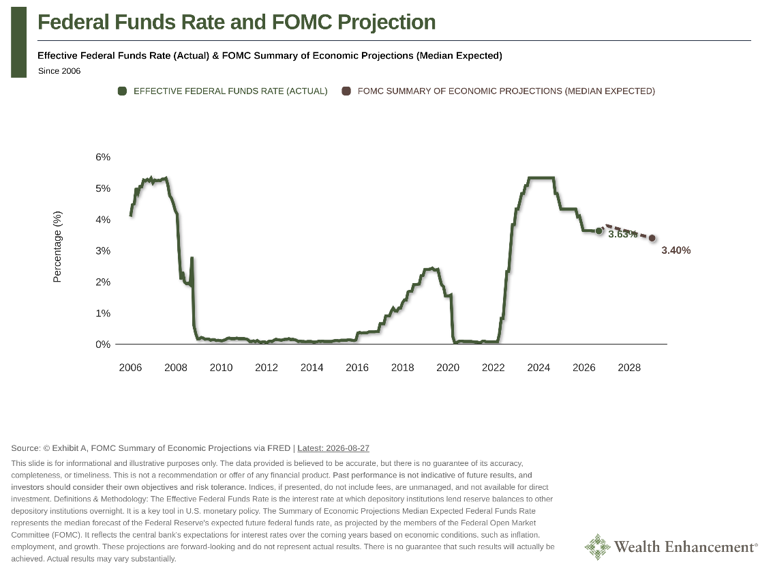
Transcript
Hello out there. Welcome to the Weekly Market Movers. My name is Gary Quinzel with Wealth Enhancement. Let’s cover the week of August 24 through 28.
Last week, we saw broadly positive returns from most equity markets. The MSCI Emerging Markets Index climbed around 1.65%. We saw the tech-heavy Nasdaq 100 gain 1.4%, while the broad U.S. large-cap index, the S&P 500, climbed around 0.8% and is still hovering relatively close to all-time highs.
The international developed index, the MSCI EAFE Index, climbed 0.2%, while we saw U.S. small caps, as represented by the Russell 2000, dip around 0.7%. Though it’s worth noting that small caps continue to outpace large caps year to date.
Looking at fixed income, we saw yields on the 10-year climb around 0.2%, but from a total return perspective, investment-grade credit gained around 0.1%, while high-yield credit gained around 0.2%.
For commodities, we saw mostly lower results. Gold was down around 4%, WTI crude was down 2%, which is a relatively modest move by today’s standards, and we saw the Dollar Index climb around 0.7%.
But let’s break down what was really driving markets. I think we have to start by talking about the NVIDIA earnings report last week. It was really all about NVIDIA, as their revenue and earnings per share were ahead of consensus.
We saw revenue up around 106% year over year, and more importantly, their forward-looking guidance for fiscal year 2028. They’re calling for 70% revenue growth, which far exceeded the Street’s estimate of around 45%.
It’s really worth noting, though, that CEO Jensen Huang mentioned that the 70% estimate is supply-constrained. What he means by that is that supply, not demand, is the binding constraint that’s going to limit revenue on a go-forward basis because securing power for the AI data centers that are the big driver behind NVIDIA’s revenue growth takes years to build out, with land acquisition, power buildouts, the shell, and cooling technology all cited as key bottlenecks.
If it were not for those supply constraints, their estimate is that revenue growth would be as high as 100%, which is very positive for the ongoing AI tailwind that has been boosting markets.
But if you look at what’s driving the revenue numbers, it really is still about the hyperscalers. They do comprise roughly 92% of total revenue. As we’ve talked about in the past, however, we are continuing to see expansion of that demand base. We’re seeing AI labs, enterprises, industries, and sovereign customers all making up a bigger slice of that pie on a go-forward basis.
So why does this matter? Well, it means the AI supply chain has benefited from the NVIDIA news. We saw memory makers do well, the Microns and the SK hynixes. We see power and infrastructure companies continuing to benefit from this because, as Huang mentioned, it’s going to take years and major investments into energy and land to build out these data centers and the associated cooling technology.
As I mentioned, the broadening demand base helps validate this AI story. So the key debate is whether or not this AI CapEx cycle continues and for how long, and whether or not we see earnings growth or return on investment come out of that cycle.
So, all in all, a positive report. But let’s shift gears now and talk more about the Fed’s annual meeting at Jackson Hole and Kevin Warsh’s address, which was perceived as a little bit hawkish.
In other words, he continues to be somewhat concerned about the stickiness of inflation, and he reassured investors that the 2% target remains firm and intact. The market didn’t necessarily love that news because, of course, the market is looking for rate cuts, which we don’t see happening anytime soon.
In fact, if you look at Fed futures, they’re calling for a 60% probability of a rate hike in September at their meeting on September 16. Now, we’re not so sure about that, but Fed futures are calling for up to two hikes this year, which is a notable shift from just a few weeks ago.
Now, Warsh did reinforce an upbeat tone around the overall economy, and there’s a lot of evidence to back that up. In fact, nominal growth of U.S. GDP was upwardly revised to 6.6% recently, and that’s backed by a number of factors: overall accommodative policies, both from a monetary as well as a fiscal perspective, along with other positive developments such as lower tax rates, accelerating bank loans, and broadly healthy credit markets. All are supporting this healthy overall economy.
But the challenge, of course, is those sticky inflation indicators, such as the PCE deflator. If you break down some of the components of the NFIB Small Business Report, consumer expectations, Conference Board leading indicators, prices within the ISM survey, as well as five-year inflation swaps, they all suggest that inflation is just a little stickier and higher than we’d like it to be. So the Fed is really going to continue to pay attention to that on a go-forward basis.
Now, as we shift gears and look forward to what to watch this week, it’s really all about the upcoming labor report, which is going to be the pinnacle economic release of the week.
We’re going to see the Job Openings and Labor Turnover Survey on Tuesday, followed by the ADP private payrolls report on Wednesday. We’ll get some insight from the ISM Manufacturing Survey on Thursday, but Friday’s payrolls report certainly is the marquee event.
The Street is calling for the addition of around 60,000 jobs, which would be a nice uptick from last month when we actually lost 23,000 jobs, a significant miss from expectations of plus 80,000. This is the last payroll report that we’re going to see before the Fed’s meeting on September 16, so all eyes will certainly be on that report.
But it’s not just the headline number and where unemployment is. It’s also some of the underlying components, particularly wage growth, and that’s something we pay a lot of attention to.
Average hourly earnings are expected to slow to 2.9% year over year, relative to 3.2% last month. That would reduce some of those inflationary impulses overall.
But arguably more important, another thing that Warsh talked about during his meeting is that his focus is really on weekly unemployment claims. We think that as long as the four-week moving average of unemployment claims remains very low, and it is at a multi-decade low currently, that would indicate that the economy is not only hiring, but that people aren’t necessarily getting laid off. That would certainly be a positive overall.
So those are this week’s insights. We hope you found them helpful, as always. If you have questions about this, please reach out to your financial advisor and tune in next week.
Thanks for joining. Take care.
This information is not intended as a recommendation. The opinions are subject to change at any time and no forecasts can be guaranteed. Investment decisions should always be made based on an investor’s specific circumstances. Investing involves risk, including possible loss of principal.
2026-13801
<a href=”/blog?keyword=&field_category%5B1886%5D=1886” class=”custom-taxonomy-link”>Investing</a>

Insights
Related resources for you
Get the latest wealth management tips and trends from our library of articles and resources.