Weekly Market Movers | October 12, 2026
6 minutes

Today on Weekly Market Movers:
- Record Stock Market Highs Mask a Narrow Rally: The S&P 500 reached a new high, but much of the advance came from a small group of large companies, while smaller stocks continued to lag.
- Oil Keeps Everyone Guessing: Shifting headlines out of the Middle East continued to move oil prices, inflation expectations, and market sentiment.
- 5% Yields Are the New Reality: Treasury yields remained near multi-decade highs as investors weighed inflation, economic growth, and the growing U.S. debt burden.
- The Economy Won’t Slow Down: Strong services activity and a healthy labor market continued to push back against recession concerns.
- AI Investors Want More Than Spending: AI investment remains strong, but investors continue to pay close attention to whether that spending is creating lasting revenue and profits.
- Bonds Are Earning Their Keep Again: Higher yields are creating income opportunities that haven’t been available to investors for years.
- The Next Inflation Reading Matters: This week’s CPI report and upcoming Fed meeting could reshape expectations for interest rates heading into year-end.
- The Earnings Bar Is High: Earnings season begins this week, with investors looking for results that can justify current market expectations.
Chart of the Week
Transcript
Welcome to the weekly Market Movers. My name is Gary Quinzel with Wealth Enhancement.
U.S. stocks finished another positive week, although the headline index masks a more uneven story beneath the surface. The S&P 500 gained about 1.2% and set a new all-time high on Tuesday, its first in nearly two months. The Nasdaq also advanced, while small caps lagged. The Russell 2000 fell roughly 0.9% as higher borrowing costs continued to weigh on more rate-sensitive companies.
International equities were generally softer, commodities remained firm, and bonds posted a modest gain despite another volatile week for interest rates. The 10-year Treasury yield finished near 5.24%. That was below its intraweek high but still close to its highest level since 2002.
There were three primary forces which drove markets this past week.
The first one was energy and geopolitical risk. Oil prices swung sharply as markets weighed continuing supply disruptions tied to the war with Iran, attacks on energy infrastructure, and late-week reports of additional diesel supply from Russia. Even though WTI finished the week only modestly higher, elevated energy costs remain important because they can flow through to transportation, manufacturing, and consumer prices.
The second force stemmed from economic data and the Federal Reserve. Overall, services activity remained solid and initial jobless claims held at historically low levels, but certain inflation details were less encouraging. The New York Fed one-year inflation expectations reached 3.9%, and the University of Michigan survey showed one-year expectations at 4.7%. Meanwhile, the September Fed minutes indicated that most officials expect another rate increase before year-end, although opinions varied on timing.
The third force driving markets was the tension between strong earnings expectations and renewed questions around the AI investment cycle. The S&P 500 reached a new record despite high yields, supported by expectations for unusually strong profit growth. But volatility in AI-related stocks showed that investors increasingly want evidence that enormous infrastructure spending is translating into durable revenue and cash flow.
Let’s now shift gears and spend just a minute more time on rates because the 10-year Treasury above 5% has implications well beyond the bond market.
There are three main reasons why yields remain elevated.
The first is persistent inflation risk. Energy prices are high, services inflation remains sticky, and consumer inflation expectations have moved higher. That gives the Fed less room to ease policy and keeps the possibility of another hike on the table.
The second reason is economic resilience. Growth has slowed in some areas, but the labor market and services economy have not weakened enough to clearly eliminate inflation pressure. If the economy can tolerate higher rates, investors will demand more yield, especially before locking money away for 10 years or more.
The third reason is the higher term premium. Investors are being asked to absorb heavy Treasury issuance against a backdrop of large federal deficits, rising debt service costs, and competing demand for capital from areas such as AI data center construction. That uncertainty adds compensation to longer-term yields even when the expected path of the Fed funds rate has not changed that much.
For the economy, higher yields mean more expensive mortgages, business loans, and refinancing. For equities, higher yields raise the discount rate which is applied to future earnings, which can be especially difficult for smaller companies, especially those with floating-rate debt. This helps explain why the S&P 500 is reaching new record highs while the Russell 2000 small-cap index has declined.
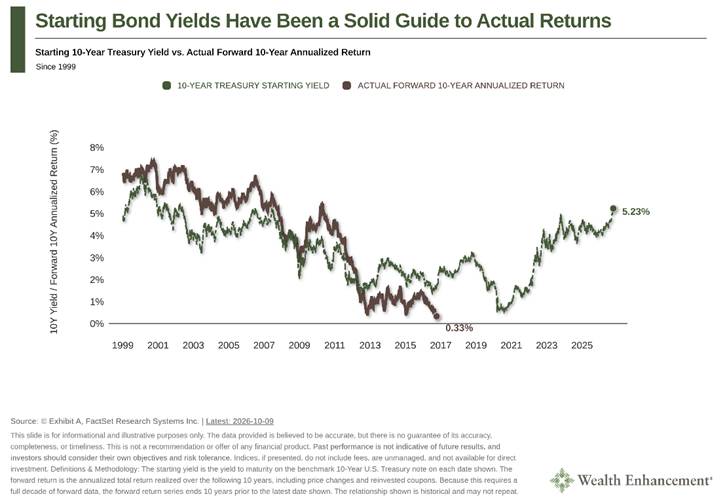
At this point, I’m gonna share a chart, and I’d like to highlight a different perspective for long-term investors because there is another side to the story.
This chart compares the starting 10-year Treasury yield with the annualized return earned over the following 10 years. The two lines have historically tracked each other fairly closely. This makes intuitive sense. When starting yields are higher, investors begin with more coupon income, and that income can then be reinvested at more attractive rates.
The message is not that bond prices cannot fall in the short run or that today’s yield guarantees a specific return. Rates could still move higher as inflation, fiscal policy, and Fed expectations evolve. The message is that forward-looking return opportunity in high-quality fixed income is much more attractive today compared to when yields were near zero. Volatility, of course, is the price of entry, but income now provides a much more meaningful cushion.
Looking ahead, the next major tests are Wednesday’s CPI report and the Fed’s late-October meeting. Our base expectation should be continued rate volatility rather than a straight line in either direction. Inflation is still too high for the Fed to declare victory, but strong demand at this week’s 10- and 30-year Treasury auctions suggests that investors are beginning to see value in bonds.
So finally, I’d like to comment on Q3 earnings season, which begins in earnest on Tuesday, led by JPMorgan, Citigroup, among others.
Expectations are sky-high. FactSet currently projects S&P 500 earnings growth of around 29.6% from a year ago, which would be the third consecutive quarter above 25%.
History also suggests that the final number could be much higher. In 37 of the past 40 quarters, actual earnings growth ultimately exceeded the estimate in place at quarter-end. Using the most conservative historical pattern, FactSet estimates that third-quarter growth could finish above 35%.
Now, when we’re looking at the earnings results, there are four things that we’re looking at.
First, for the banks, listen for trends in net interest income, loan growth, credit quality, and deal activity.
Second, we’re watching whether companies can protect margins from higher energy, freight, and input costs.
Third, we’re paying close attention to management guidance because stock prices already reflect a strong earnings backdrop.
And fourth, for the large technology companies, investors are all focusing on AI capital spending, capacity, and increasingly the return being earned on their AI investments.
The bottom line is that markets are balancing two powerful forces: higher interest rates are tightening financial conditions and whether earnings growth remains strong enough to validate today’s equity prices.
The next few weeks should tell us a lot about whether profits can continue to outrun the pressure from higher rates. We’re gonna be watching both sides of that equation closely.
Thanks for joining us, and we’ll see you next week. Take care.
This information is not intended as a recommendation. The opinions are subject to change at any time and no forecasts can be guaranteed. Investment decisions should always be made based on an investor’s specific circumstances. Investing involves risk, including possible loss of principal.
2026-14328
<a href=”/blog?keyword=&field_category%5B1886%5D=1886” class=”custom-taxonomy-link”>Investing</a>

Insights
Related resources for you
Get the latest wealth management tips and trends from our library of articles and resources.