
Weekly Market Movers | July 20, 2026
6 minutes

Today on Weekly Market Movers:
- Markets fell last week, largely because technology and semiconductor stocks – the makers of computer chips that power AI – lost ground.
- Investors are starting to wonder if all the money being spent on AI will actually be worth it.
- Oil prices jumped as tensions in the Middle East continued, creating more uncertainty.
- Despite the recent market decline, many companies are still expected to grow profits (earnings) this year.
- Stock prices are already very high, so investors are watching closely for signs of trouble. Are they overvalued, or will they continue to grow?
- With uncertainty around AI, oil prices, interest rates, and global events, it’s important not to put all your eggs in one basket. Stay diversified.
Chart of the Week
Watch the full video
Transcript
Greetings, everyone. Welcome to the Weekly Market Movers. My name is Gary Quincel with Wealth Enhancement.
Last week, we saw markets mainly finish in the red. We saw the S&P 500 lose about 0.7 percentage points. The Nasdaq did a little bit worse. Most equities were in the red, but we did see some positive flows into some Asian indices, most notably emerging markets.
Let’s unpack what’s happening in the semiconductor sector, which has been top of mind lately for a number of reasons, most notably the significant run that it’s been on. Now, it’s actually working in the opposite direction.
We saw the Philadelphia Semiconductor Index fall around 10% last week. It’s officially now in bear market territory, although it should be noted that it seems to be bouncing back quite often, so we’ll be paying close attention to that.
There have been a lot of significant contributors to what’s happening there. Late last week, there was a new Chinese startup company, which was kind of a deepfake moment from early in 2025, when the market was concerned about cheaper alternatives coming for high-technology U.S. components. We’re experiencing that same thing right now, and so we will certainly be paying attention to that, as well as earnings from companies such as Taiwan Semi, which had better-than-expected earnings. At the same time, the market was a little uncomfortable with the amount of CapEx associated with that.
As always, there’s a lot happening there. For those who are overexposed in that sector, we saw great returns, of course, in companies like Micron, Samsung, and SK Hynix, but now we’re seeing some of that work in reverse. That volatility has spilled over into the rest of the market.
We also saw tensions escalate because of what’s continuing to happen in Iran. As a result, we saw oil spike upward around 15% last week. Brent oil rose to around $88, and WTI crude rose to around $82. That upward revision in oil is certainly hitting some countries harder than others, but I think it’s really the uncertainty that’s going to linger in the market as long as we have this unknown timeline of how long this could potentially continue.
Of course, the market has looked through that and has rallied considerably, but when we layer in the volatility associated with the AI trade, most notably semiconductors, we have a situation where the market seems to be trying to find its footing.
I want to spend a moment talking about what we believe is always driving the markets, and that’s the fundamentals.
As we’ve talked about in the past, the market is historically more highly valued than it has been. We often quote metrics such as the price-to-earnings ratio. If you look at the forward price-to-earnings ratio of the S&P 500, it’s around 21 times, which is a little elevated compared to normal. The 10-year average is around 20 times earnings, while the 20-year average is around 17 times earnings. So, the valuation methodology certainly indicates that the S&P 500 is a little rich.
But if you look at what’s behind that, there are two components that go into a price: the valuation premium and the earnings that drive that stock underneath it.
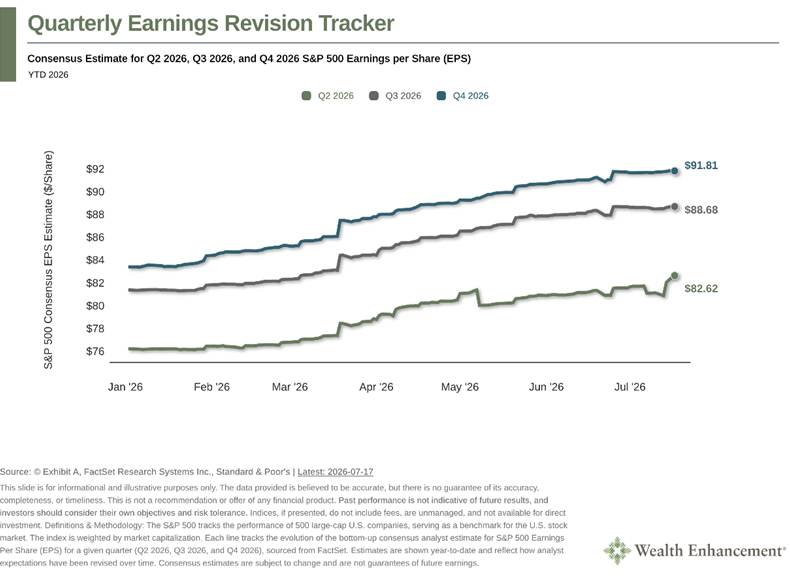
Here, I’m sharing the quarterly earnings revision tracker, which shows how expectations for Q2, Q3, and Q4 earnings have evolved throughout the year. What we can see is that they have consistently trended upward. In other words, the market continues to have a more optimistic view of what it’s expecting from U.S. large-cap companies.
The latest projection for Q2 is around $82.62 in earnings, which is roughly a 25% year-over-year increase relative to last year. So, the market is pricing in really phenomenal growth. If you look at what it’s expecting for Q3 and Q4, those projections are even higher. Much of that is driven, of course, by these AI tailwinds that we keep talking about.
There is a lot of momentum behind the trade and a rationale for why we’re continuing to climb higher in spite of these uncertainties and what’s going on overseas. The fundamental story is quite strong.
In fact, I already referenced the price-to-earnings ratio relative to history. If we take a look at the price-to-earnings-to-growth ratio, which compares that same measure to forward-looking growth expectations, that ratio is around 1.5x.
What does that mean? Typically, a price-to-earnings-to-growth ratio around 1 or below 1 is considered attractive. So, we’re not necessarily attractive, but we’re not necessarily expensive either. If you compare that PEG ratio to the 10- or 20-year average, it’s actually much higher on a historical basis, around 2.5 to 3 times, depending on the time period.
We’re really not that concerned about valuations relative to growth, as long as the growth continues to materialize as expected. The risk, of course, is that things could turn on a dime. If some of the expected growth that the market is pricing in relative to the AI trade does not materialize, then we could be in a situation where we would not have quite as much optimism about the future path of equity markets.
One last thing I want to point out, which I think is really interesting, is the equity risk premium. This takes the inverse of the price-to-earnings ratio—the earnings yield—and compares it to the 10-year Treasury yield.
The earnings yield is currently around 4.83%; that’s the inverse of the 21 price-to-earnings ratio I mentioned. The 10-year Treasury yield is around 4.55%, so that’s only about 28 basis points of extra yield that investors are being rewarded with for investing in something riskier.
What does that mean? That’s very low relative to history. The equity risk premium was typically around 300 to 400 basis points during the post-GFC period. The last time it was this low was in the lead-up to the Global Financial Crisis.
That doesn’t necessarily mean we’re heading toward that again—not by a long shot. But it does suggest that there isn’t a lot of room for error. In other words, if there were a spike in interest rates—say the earnings yield stayed the same in the S&P 500, but the 10-year yield rose by around 50 basis points—that would mean the equity risk premium goes negative. That’s when the market starts to reprice its perception of risk.
These are great reminders of why we maintain diversification and why we work with our advisors to ensure our portfolios are well balanced and that we understand the risks that are present in the market.
As always, there’s a lot happening out there driving the markets. We hope you found this week’s insight helpful, and as always, reach out to your advisor if you have any questions.
Thanks, and have a great week.
This information is not intended as a recommendation. The opinions are subject to change at any time and no forecasts can be guaranteed. Investment decisions should always be made based on an investor’s specific circumstances. Investing involves risk, including possible loss of principal.
2026-13254
<a href=”/blog?keyword=&field_category%5B1886%5D=1886” class=”custom-taxonomy-link”>Investing</a>

Insights
Related resources for you
Get the latest wealth management tips and trends from our library of articles and resources.


