Weekly Market Movers | August 3, 2026
10 minutes

Today on Weekly Market Movers
- Tough July: Stocks struggled in July—especially tech and emerging markets—though most major asset classes remain strong for the year.
- AI Spending Needs Results: Investors keep demanding proof that AI spending is driving real business growth and profits—and rewarding companies that do.
- Tech Rebound: Microsoft and Amazon helped markets rebound by showing strong earnings tied to their AI and cloud businesses.
- Rates Higher for Longer: The Fed decided to hold rates steady, but growing support for a rate hike kept “higher for longer” concerns in focus.
- Rising Bond Yields: Bond yields continued to climb as investors priced in the possibility of prolonged higher interest rates.
- Currency Watch: Japan stepped in to support the yen, highlighting ongoing risks in global currency markets.
- What’s Next: Investors will be watching earnings from SpaceX and AMD—a major computer chip company—along with the July jobs report for clues on AI, the economy, and interest rates.
Watch the Full Video
Chart of the Week
Transcript
Hello and welcome to this edition of Weekly Market Movers from Wealth Enhancement. My name is Aya Yoshioka, Director and Senior Investment Strategist.
In this video, we will focus on three things.
First, we’ll talk about performance across markets ending July 31. Second, we’ll talk about key macroeconomic and corporate news that drove some of these moves. And lastly, we’ll look ahead to the first week of August and highlight what we’re keeping our eyes on.
All right, let’s start by looking at year-to-date returns across asset classes.
Last week, we had a bit of a rebound as we ended the week, but in general, July was a tougher month for equity markets. While the S&P 500 Index was flat for the month, the tech-heavy Nasdaq-100 was down nearly 7%. Small caps pulled back about 3%, and the MSCI Emerging Markets Index pulled back 3% as well, mainly because the South Korean market, measured by the KOSPI Index, was down over 20% in the month of July alone.
Despite all of this, when we look at the year-to-date chart here, we still have very strong returns.
U.S. large caps are up 10% in 2026.
Small caps have returned double that, and emerging-market stocks are still up nearly 18% despite this recent volatility.
Commodities are leading the pack this year, mostly thanks to energy markets and the supply disruptions that have been caused by the conflict in Iran.
Notably, gold has taken a bit of a breather this year and is down 6% year to date, as central bank buying has slowed amidst a higher interest-rate backdrop. Higher interest rates on government bonds tend to provide a little more competition to the shiny metal.
In fixed income, we saw higher Treasury yields as we ended July, with the two-year yield ending at 4.29%, up 12 basis points from the end of June.
The 10-year yield ended the month at 4.73%, a 52-week high, and the 30-year closed at 5.27%. That’s the highest yield we’ve seen on that.
Now that we’ve recapped last week’s market moves, let’s dig into what drove these moves.
And since we’re in the midst of earnings season, let’s start there.
We’ve had 307 S&P 500 companies, representing 66% of the index’s market cap, report so far.
In general, EPS has come in better than expected by about 7%, and sales have come in better than expectations by about 3%.
Collectively, the S&P 500 is on track to grow earnings by 29% compared to the same quarter in 2025.
What has been a bit wilder this earnings season has been the price reaction to earnings, especially for some of the bigger tech names, or the Magnificent Seven names.
We started the week with signs of some unease around stocks exposed to the overall AI thematic, as investors questioned whether or not we’d see a return from all the spending these Magnificent Seven stocks are making.
Additionally, we had some tech stocks across the globe get pretty pressured over the last few weeks as South Korean retail investors had to deleverage and some institutional hedge funds, such as Situational Awareness, got margin calls and were forced to liquidate.
However, the week really ended on a positive note, thanks to a comeback in some of these large tech stocks.
One of the things I would like to highlight is that Microsoft soared 16% following its earnings report and posted its best week since 1999.
Microsoft reported 43% growth for its cloud services segment while remaining disciplined on capital spending plans.
Amazon was up 15% after the company reported strong earnings as well, a move this big had not been seen since 2012.
Amazon reported 37% growth in its cloud services segment, known as Amazon Web Services, or AWS.
For the four mega-cap tech firms that have reported, Amazon, Alphabet, and Meta all increased their capital-spending outlook, while Microsoft reaffirmed its spending plans.
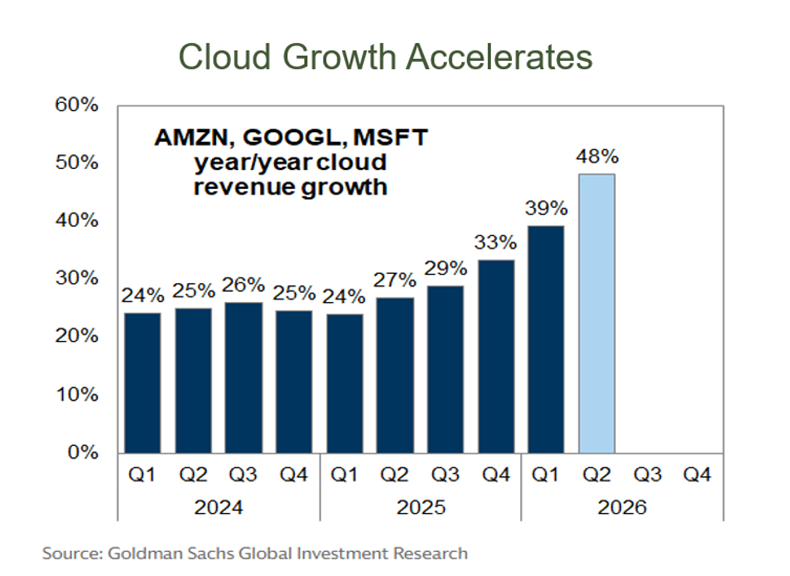
The companies that showed progress that justified spending were applauded, while those who did not were penalized. The way that we’re seeing the return on investment is really through cloud-services growth. You can see here on this chart that collective cloud-services revenue growth is at 48% when you combine Amazon, Google, and Microsoft.
Outside some of the big earnings reports, we did have a Fed meeting, and the Fed meeting may have looked a little uneventful on the surface as the committee kept rates unchanged.
But we had three members dissent, and those members favored a 25-basis-point hike due to inflation risks. Kevin Walsh emphasized the importance of price stability, but the bond market voted with higher yields.
Thus, while risks remain tilted toward a potential hike versus a cut, the market will take a look at the next round of inflation and labor-market data to reflect its views on whether or not the Fed needs to make a move or remain on hold.
Now shifting to currency markets, I know it’s a market that we don’t always talk about, but there was another event at the end of last week that we wanted to highlight.
And that was the intervention in the Japanese currency market.
The Japanese yen has been trading near 40-year lows, around 163 yen per dollar.
With that, Japan’s Finance Ministry and the U.S. Treasury Department worked together to shore up the currency.
The yen had been under pressure as higher oil prices, a persistent budget deficit, and wide interest-rate gaps between Japan, the U.S., and other developed countries remained. Thus, at the end of last week, Japan sold U.S. dollars and bought Japanese yen, while the U.S. sold euros to buy Japanese yen.
Now, as we start August, the yen is near 156 yen per dollar.
In other words, the yen has strengthened.
The intervention signals to the market that policymakers have a bit of a pain threshold near that 160-yen-per-dollar level.
Investors have long worried that a persistently weak yen would force selling of U.S. Treasuries, since Japan is one of the largest foreign holders of U.S. Treasuries.
The concern is that there would be a spillover effect into stocks and bonds.
We’ll continue to monitor what is going on here in the currency market.
It is always a concern. I know last year, or two years ago, we had the blip in August around that yen carry trade.
With that, let’s look at what’s coming this week.
From a corporate earnings standpoint, SpaceX will report earnings for the first time since going public, and AMD, a semiconductor name, will provide a little more color on the whole AI trade.
We’ll also get some insight into the state of the consumer, with companies like McDonald’s, Disney, and Uber reporting this week.
From an economic data standpoint, we’ll get the Institute for Supply Management, or ISM, surveys, both in manufacturing and in services.
But the star of the show from an economic standpoint will be the July labor report that we get on Friday, August 7. Economists estimate that we’ll add 86,000 jobs in July, an uptick from the 49,000 jobs that were added in June.
Economists also expect the unemployment rate to stay steady at 4.2%.
So, with that, that’s all I have for you this week. Thank you so much for watching, and we’ll see you again next week.
This information is not intended as a recommendation. The opinions are subject to change at any time and no forecasts can be guaranteed. Investment decisions should always be made based on an investor’s specific circumstances. Investing involves risk, including possible loss of principal.
2026-13483
<a href=”/blog?keyword=&field_category%5B1886%5D=1886” class=”custom-taxonomy-link”>Investing</a>

Insights
Related resources for you
Get the latest wealth management tips and trends from our library of articles and resources.