
The First Dollar: Research on How Families Prepare Kids from Piggy Banks to Portfolios
5 minutes

More than half of parents and grandparents say that kids today are less financially prepared than they were growing up. Wealth Enhancement explores why this may be – and what families can do to flip the script.
- Majority View: 53% of parents and grandparents say children today are less prepared to manage money as adults than they were at the same age.
- Room to Grow: Despite concerns about financial preparedness, more than half of survey respondents (53%) have never opened an investment account for their children.
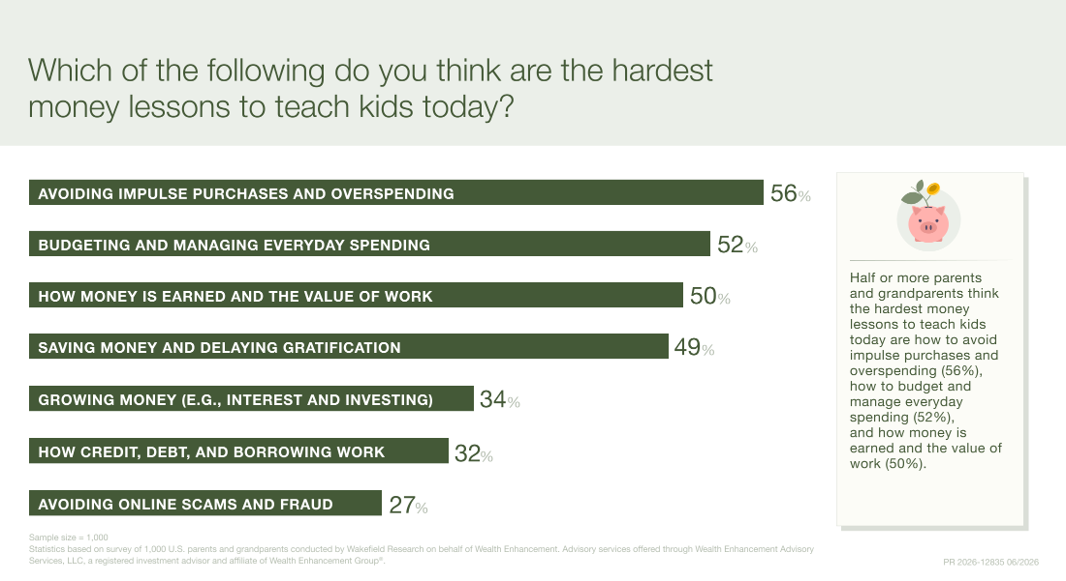
- Hard-Earned Lesson: The majority of respondents (56%) believe that avoiding impulse purchases and overspending is the hardest money lesson to teach kids.
- Cha-Ching: More than half of survey participants (63%) have given their children an allowance, and they believe $18 per week is a fair, first weekly amount.
Today’s younger generations are inheriting a more complex world than previous generations, making money management more important than ever – and perhaps more challenging, too. Most parents and grandparents aren’t optimistic about their children’s readiness to manage money as adults, according to recent research from Wealth Enhancement.*
A survey of 1,000 U.S. parents and grandparents finds shared cross-generational concerns about their kids’ financial preparedness. But the results also show striking differences around beliefs for how to best equip kids, including setting up investment accounts, giving allowances, and teaching hard money lessons.
Financially Unprepared
More than half of survey respondents (53%) believe children today are less prepared to manage money as adults than they were when they were growing up. Just 29% believe children today are better prepared.
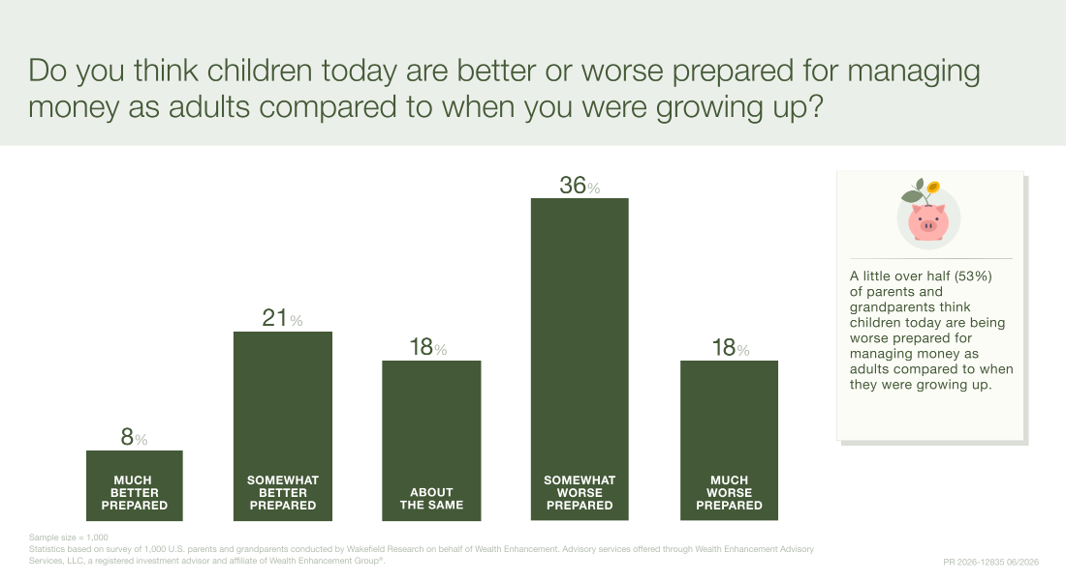
Grandparents (61%) and Baby Boomers (61%) were most likely to believe today’s children are less prepared financially. Millennials were less likely to share that view.
Today’s digital-first environment creates entirely new financial challenges for families, according to Chloé Briel, CFP®, Senior Advanced Planning Manager at Wealth Enhancement.
“Money, like so many other commodities today, can feel instantaneous,” she says. “You can send your kids money through digital banking apps instantly. We’re not having to go to the bank and get cash.”
She says that ease of access can make financial boundaries harder to teach.
Investment Inaction
Despite concerns about financial preparedness, many families aren’t investing for their children’s futures. More than half of parents and grandparents (53%) have never opened an investment account for their child.
Grandparents and Baby Boomer parents are most likely to have never opened an investment account (both 63%), while fewer than half of parents (42%) and Millennials (41%) say the same. As families begin discussing investment decisions, she encourages them to think holistically about long-term planning. For families that are ready to save, she says flexibility and long-term goals matter.
“Being in the market for a longer timeframe allows you to move with the market without the heightened level of stress or risk that short-term investing can bring,” Briel says. Briel recommends considering the growing flexibility of 529 plans and long-term family planning strategies: “Overfunding a 529 plan is a common concern, but it can actually be something that could be done on purpose as an estate and wealth transfer strategy. Given the unique tax status, any excess funds may be shifted to another eligible family member, helping extend educational support to future generations like grandchildren.”
Hard-Earned Money Lessons
Survey respondents agree the most difficult financial lesson to teach children today is how to avoid impulse purchases and overspending (56%).
Other difficult lessons include:
- Budgeting and managing everyday spending (52%)
- Understanding how money is earned and the value of work (50%)
- Saving money and delaying gratification (49%)
Only about one-third (34%) said teaching children how to grow their money (e.g., interest, investing) was among the hardest lessons.
Today’s spending environment is designed around convenience, says Briel. She points to social media, one-click purchasing, and rapid delivery services as factors shaping spending behavior for both adults and children. “The world is built for impulse. It makes sense that it’s challenging to teach, most adults struggle with this.”
Rather than relying solely on lectures, she encourages families to involve children in financial decisions and conversations. Examples include creating a family vacation budget, comparing prices, or discussing how long-term purchases fit into household priorities.
Money Maturity
Allowance remains one of the most common ways adults teach children about money management. Most adults (63%) give their children an allowance, including 68% of parents and 58% of grandparents.
Briel says allowance can help children build decision-making skills and healthier habits before adulthood. “It gives some agency over their finances in a safe and manageable way,” she says. “You want to set them up on the path for making good choices as often as possible.”
According to the survey, the most common age to begin offering an allowance is 8 years old, and more than half (51%) of respondents say they started between ages 5 and 12.
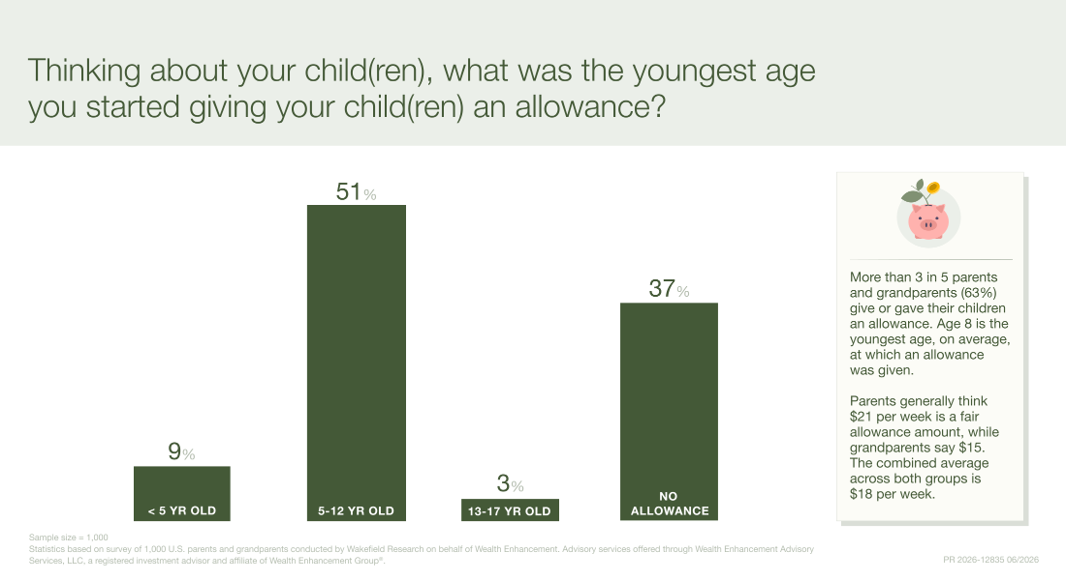
How much is the right amount? Parents generally think $21 per week on average is a fair allowance amount, while grandparents say $15. The combined average across both groups is $18 per week.
Briel recommends parents think intentionally about the purpose behind an allowance: “It goes back to intent and values. Are you hoping they’ll save up for something they want? Buy a gift? Fill up their piggy bank?”
For younger children, she says even small purchases can become meaningful teaching moments: “Kids can develop a sense of ownership and care in the items they buy themselves. There’s a sweetness in that.”
Financial Values Shape Financial Habits
Briel believes many financial conversations should begin not with budgeting or investing, but instead with values. She encourages parents to reflect on their own childhood experiences with money and how those memories influence their financial outlook today.
According to Briel, families often unconsciously pass down financial beliefs, anxieties, and behaviors unless they intentionally discuss them. She recommends parents and guardians talk openly about what their family values most, whether that’s travel, education, experiences, security, generosity, or saving for the future.
“Some families value material things, whereas others value experiences and trips,” says Briel. “All of that is ok within the context of value-focused money management.”
Briel says these conversations help children understand not just how money works, but why families make the choices they do.
What Should Adults Focus On?
- Set Your Family’s Financial Values: Discuss what matters most as a household and align spending decisions around those priorities.
- Prepare for Retirement First: Building long-term financial stability for parents creates more flexibility and security for children later.
- Take Incremental Steps: Teaching financial preparedness doesn’t happen overnight. Small lessons around saving, spending, and patience build over time.
- Teach Kids Through Everyday Experiences: Use age-appropriate decisions like shopping, vacations, allowances, and saving goals as learning opportunities.
Preparing for the Future
The findings paint a clear picture: Parents and grandparents are concerned about children’s financial readiness, but there are meaningful ways to help build stronger financial habits over time.
“Financial preparedness starts with consistent conversations, intentional modeling, and understanding family values,” Briel says. “Whether through allowances, investing, budgeting conversations, or everyday purchasing decisions, small moments can help children build confidence managing money in the future.”
Methodology
The Wealth Enhancement “The First Dollar” survey was conducted by Wakefield Research among 1,000 representative U.S. parents and grandparents (500 of each), between April 28th and May 4th, 2026, using an email invitation and an online survey.
Results of any sample are subject to sampling variation. The magnitude of the variation is measurable and is affected by the number of interviews and the level of the percentages expressing the results. For the interviews conducted in this particular study, the chances are 95 in 100 that a survey result does not vary, plus or minus, by more than 3.1 percentage points for the total sample, and 4.4 percentage points for each audience (Parents/Grandparents) from the result that would be obtained if interviews had been conducted with all persons in the universe represented by the sample.
About Wealth Enhancement
Wealth Enhancement offers integrated financial planning grounded in clear, detailed advice. With local offices around the country, your advisor is backed by a network of specialists who can support your financial needs, no matter how complex. This is because we also provide estate planning, tax strategy, investment management, insurance consultancy, and retirement income planning, as well as business consulting services.
Since 1997, Wealth Enhancement has delivered specialized knowledge, attentive service, and detailed planning. Our financial plans are crafted with care, tailored with compassion, and built to handle what life brings.
Advisory services offered through Wealth Enhancement Advisory Services, LLC, a registered investment advisor and affiliate of Wealth Enhancement Group®. Wealth Enhancement Group is a registered trademark of Wealth Enhancement Group, LLC.
2026-13563
<a href=”/blog?keyword=&field_category%5B11%5D=11” class=”custom-taxonomy-link”>Financial Planning</a>

Insights
Related resources for you
Get the latest wealth management tips and trends from our library of articles and resources.


