Weekly Market Movers | October 19, 2026
10 minutes

Today on Weekly Market Movers:
- Most Stocks Actually Gained: The S&P 500 and Nasdaq fell, but about 7 in 10 S&P 500 companies finished the week higher.
- AI Financing Gets Expensive: Tech and chip stocks dropped as investors dug deeper into the cost of building data centers and how companies plan to pay for them.
- Prices Picked Up Again: Consumer and producer prices rose more than expected, even as other data showed the economy remains healthy.
- Oil Crossed $100: Middle East tensions and tighter supplies drove crude prices sharply higher again, adding to costs throughout the economy.
- Bonds Did Their Job: Treasury prices rose as stocks fell, while today’s higher yields continue to offer investors more income than they have in years.
- A Packed Earnings Week: Meta, Tesla, IBM, Netflix, and others report quarterly earnings this week, offering a broad look at corporate spending, profits, and consumer behavior.
Charts of the Week
Transcript
Good morning and welcome to Wealth Enhancement’s weekly Market Movers video series. My name is Doug Huber, and I’m the Deputy Chief Investment Officer here at Wealth Enhancement. Hope everyone’s week is off to a great start. I look forward to getting into what drove markets last week and what we’re watching in the markets and the economy this week.
I think last week was a really useful reminder that the headline index and the average stock can tell two very different stories.
On paper and from an index level, last week was a difficult week. The S&P 500 declined about 1.9%, the tech-heavy Nasdaq was down 4.5%. But that’s in contrast to the Dow, which gained seven-tenths of 1%, and the equal-weighted S&P, which rose roughly half a percent.
If you look under the S&P 500, roughly seven in 10 companies of those 500 constituents were actually positive for the week. And I think that contrast tells us that last week was not a uniform market liquidation, right? It was primarily a correction in tech, semi, and large-cap growth. Looking into that, information technology was actually down 6% last week, semiconductors down 11%, and the poster child of the AI boom, Nvidia, was down about 7%.
But if you look, consumer staples and energy were both up 5%, while healthcare, utilities, materials, and financials all finished the week higher as well.
And so the most important dynamic last week was really how investors are evaluating artificial intelligence. Recent earnings that are coming out of these major chip companies continue to show really strong demand, but investors are focusing more intensely on how these data centers are being financed. How much more capital are we going to need to get these through completion? And then when is that investment actually going to return something back, right? When is it going to produce those durable cash flows?
And I think you saw that in something like a neo-cloud provider, CoreWeave, right? They essentially rent out data center capacity. That was down roughly 25% last week as investors really raised questions into that business model. Some of its debt even reached what we call distressed levels, and that rippled through to other bonds tied to large data center financing projects, and they were much weaker.
But I think it’s important to keep that in proportion, right? Broad investment-grade spreads widened only very slightly last week, and even the overall high-yield market moved far less than a lot of these AI issuers. And so I think this was a meaningful warning, or at least a showing that the market is paying a lot more attention to these financing structures, but it’s not evidence that corporate credit as a whole has ceased to function.
I think on the other side of the trade, the economic data also had an interesting contrast. We saw September consumer prices increase six-tenths of 1%, producer prices rise almost 1.3%. Energy was the largest driver of those, but we also saw that ripple through core consumer prices, producer services, and non-fuel import prices, increasing more than expected.
At the same time, though, you saw retail sales rise eight-tenths of a percent, industrial production rise seven-tenths, and unemployment claims continue to remain below 200,000. I think these are all figures that are arguing against an imminent recession and actually show that, for the most part, we have a pretty healthy economy.
Housing remained weaker. Obviously, all-time highs in pricing are impacting sales. Existing home sales improved modestly, but they’re still very near historic low levels. You also saw the Federal Reserve’s Beige Book describe cautious consumers and really little net change in employment.
Oil added another complication last week. West Texas Intermediate gained more than 10% and finished above $100 a barrel, while Brent rose nearly 5%.
I think the attacks affecting shipping and energy infrastructure, together with a large decline in U.S. crude inventories, increased both the physical supply concerns as well as that geopolitical risk premium, which, let’s be honest, will continue to be there until there is more of a resolution with the Iranian conflict.
Oil is lower this morning after the United States waived some selected sanctions affecting Russia, which would potentially allow more fuel into the global markets. I think while the policy change is certainly real, there are a lot of questions around the volume of that additional supply, and it’s really not yet known. Frankly, that Middle East shipping risk is also known. It’s just going to remain the largest important factor as it relates to oil prices.
Despite all that, Treasuries actually rallied despite this inflation news. The two-year yield fell to around 4.73% to end the week, the 10-year at 5.1%, far off its highs closer to 5.3%, and the 30-year at 5.44%. Most of that came through lower real yields as investors really sought that safety during the sell-off. And I think it’s really good to see that what historically has been kind of the safe-haven asset continues to behave like that.
But, you know, I do not think it was a result of longer-run inflation compensation actually lowering. In fact, it probably edged a little higher. And so it’s certainly not evidence that inflation concerns have disappeared, but it is evidence that Treasuries continue to act as a shock absorber in the market.
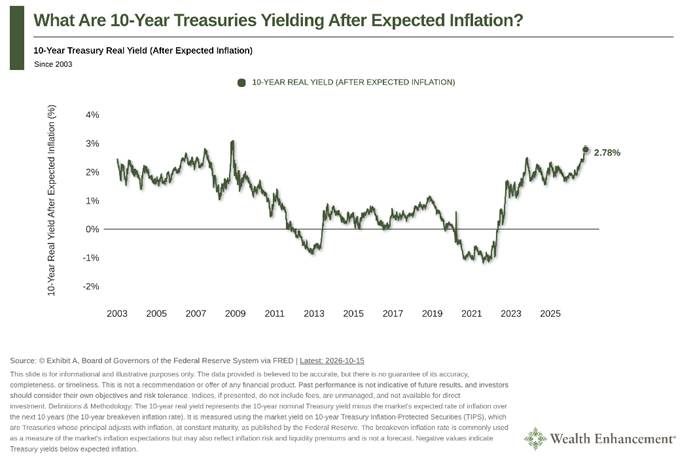
And I think with that, I’d like to share a couple of charts here specifically about the Treasury market because I think we’re at an interesting point in where we’ve gotten to with Treasuries. I think this shows what we call the real yield, right?
And this is the yield to an investor after you remove expected inflation. The 10-year real yield is now hovering in the high 2% range. And you can see that over the last 24 years, it’s only really been in this zone once or twice during crises. And even if you rewind back almost 40 years, there have been very few times that we’ve seen close to a 3% real yield on Treasuries.
And I bring this up because now Treasuries are actually earning something above and beyond inflation. You see, there’s a big period from 2010 through essentially 2023 where you were actually not being compensated to own these assets. Today, you are.
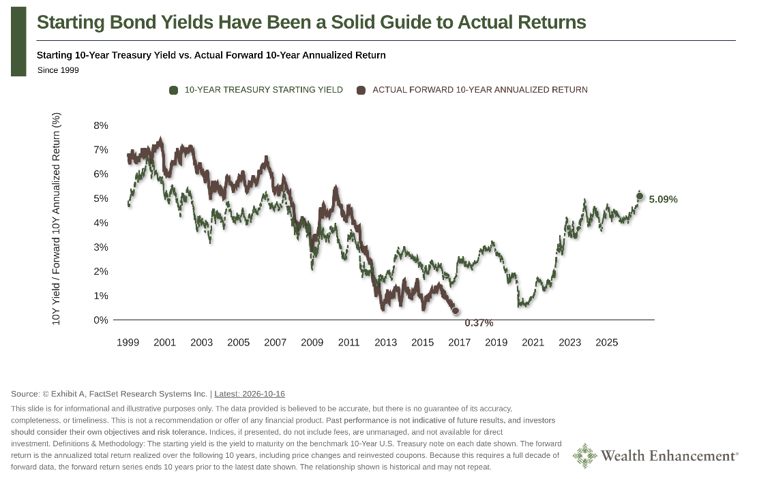
You combine that with the fact that I think the most important thing that determines the future returns of U.S. Treasuries is the starting yield. This is a great chart that shows, in the green dotted line, the 10-year Treasury starting yield in that particular year.
And then the red line is actually the forward 10-year actual return for holding that instrument. And you can see they track very closely. So if you bought a 10-year bond back in 2016 and held it over that next 10 years, you would have earned around zero, right? 0.37%.
But as you can see where we are today, this creates a much higher prospect for a return north of 5% over the future 10 years, and it’s doing so with a real return, so above inflation, of 2.78% or whatever that last chart showed.
So I think what this does is, to me, it establishes at some point a ceiling of how far rates can go, right? There will be a net buyer at some point, whether that’s liability-driven investors like pensions and insurance plans or just the everyday investor who’s saying, listen, I can actually get paid to hold a relatively safe asset.
With that, let’s dive into what we see coming up this week. I think this week is really a situation in which we are going to be shifting our focus from macro toward earnings.
We have a big week for earnings. Meta, Tesla, and IBM report on Wednesday. Netflix reports Tuesday. The calendar also will have aerospace, autos, industrials, consumer, railroads, and payments all reporting this week. Those are all a good cross-section of the economy.
Meta is likely to be the most consequential market event. Investors are going to look beyond just the revenue and earnings side to look at capital spending, free cash flow, and what their plans are for AI products, and how much incremental revenue they think they will generate to justify all these new data center commitments.
Tesla is going to be looked at, obviously, for automotive margins and spending on its autonomous technology. IBM, I think the market will look toward software bookings and consumer demand. Netflix will provide a view on streaming engagement, advertising, and consumer subscription demand.
I think there’s a distinction to watch this week. Strong demand is helpful, but I think investors now want evidence that growth can fund investment rather than require continuously large amounts of outside capital.
For the week, the economic calendar is light but still relevant. Tuesday brings housing starts, building permits, and pending home sales.
We think high mortgage rates will continue to pressure affordability, so permits and single-family construction may be more useful than a volatile headline.
Wednesday, we will see a Treasury auction of 20-year bonds. Thursday brings a five-year TIPS auction, and strong demand would certainly reinforce last week’s bond rally. Weak demand would raise some concern about long-term supply and term premium, so we will be watching that.
On Friday, we get flash business surveys that show whether activity remains strong and whether higher energy and input costs are spreading through to the consumer. The University of Michigan survey will update that consumer confidence and inflation expectations number as well.
The balanced takeaway here is that the economy remains resilient, market breadth is actually better than the headline index suggests, and broad credit is still very orderly.
But at the same time, inflation remains elevated, oil remains a risk, and the financing side of AI is smack dab in the center of everybody’s attention.
And so I look forward to being back with you next week. We’ll digest all of those things I mentioned that we have upcoming this week. In the meantime, I hope everyone has a great week and look forward to talking to you soon. Thanks.
This information is not intended as a recommendation. The opinions are subject to change at any time and no forecasts can be guaranteed. Investment decisions should always be made based on an investor’s specific circumstances. Investing involves risk, including possible loss of principal.
2026-1445
<a href=”/blog?keyword=&field_category%5B1886%5D=1886” class=”custom-taxonomy-link”>Investing</a>

Insights
Related resources for you
Get the latest wealth management tips and trends from our library of articles and resources.