
Weekly Market Movers | July 27, 2026
7 minutes

Today on Weekly Market Movers:
- Technology and chip stocks (semiconductors) pulled markets lower for a second week in a row.
- AI remains a powerful long-term growth driver. But with stock prices already so high, investors want proof that the billions being spent on AI are translating to real growth, profits, and returns.
- The economy continues to look stronger than many expected, with companies still projected to grow profits this year. But this could also keep interest rates higher for longer.
- Rising oil prices and ongoing tensions with Iran have been a reminder that geopolitical risks can become economic risks if they drag on long enough.
- This week, investors will be closely watching inflation, economic data, and earnings for signs of where markets may head next.
Watch the Full Video
Chart of the Week
Transcript
Good morning, and welcome to this week’s market update from Wealth Enhancement. My name is Doug Huber, and I’m the Deputy Chief Investment Officer.
Last week gave investors a useful reminder that markets do not simply respond to whether the news is good or bad. They respond to how the news compares with expectations and whether current prices leave room for disappointment.
The major U.S. equity indices finished lower for a second consecutive week. The tech-heavy Nasdaq led that decline, while the S&P 500 and Dow held up somewhat better. Three connected forces drove most of the price action: renewed concern about the economics of artificial intelligence spending, higher oil prices tied to the conflict with Iran, and rising Treasury yields.
Let’s begin with technology. The debate around AI is evolving. Investors are no longer asking whether AI demand is real. The demand appears to be quite real. Instead, they’re asking how much companies will need to spend to meet that demand and how long it will take for those investments to generate returns that match that level of spending. That distinction mattered last week.
Results from Alphabet, Google’s parent company, and Tesla highlighted the enormous capital required for data centers, computing capacity, chips, and infrastructure. Even where revenues remained healthy, investors stayed focused on rising capital expenditures, weaker cash flow conversion, and the possibility that additional financing may be needed to fund this growth.
This does not necessarily undermine the long-term AI story, but it does raise the standards companies must meet. When valuations already reflect substantial future growth, simply announcing more investment is no longer enough. Investors increasingly want evidence that spending is translating into revenue growth, durable margins, and cash flow.
We’ve talked about this often in this series. It is increasingly about execution. That pressure extended beyond individual companies. Technology and other long-duration growth stocks weakened, while energy, aerospace, and defense generally held up better. Much of that had to do with developments in Iran, and it served as another reminder that a market dominated by a small number of very large companies can be vulnerable when expectations reset.
The second major influence for the week was oil. Tensions involving the U.S. and Iran escalated as strikes continued, and peace talks appeared to have broken down last week. Brent crude moved from nearly $70 back toward $100 amid renewed concern about shipping through the Strait of Hormuz.
Oil retreated as diplomatic efforts appeared to gain some traction over the weekend, but the earlier increase was large enough to affect both inflation expectations and interest rates. Oil matters because it reaches several parts of the economy at once. Higher energy costs can lift headline inflation, squeeze corporate margins, and reduce the amount consumers have available for other purchases. Gas and fuel remain significant expenses for many consumers.
If elevated prices persist, they can also limit the Federal Reserve’s flexibility, which brings us to the bond market.
The 10-year Treasury yield finished the week around 4.7%, roughly 15 basis points higher for the week. The 2-year yield ended at 4.3%, and longer-maturity yields also moved higher. Part of that move reflected the increase in oil, but economic data played a role as well.
Initial unemployment claims fell to 187,000, signaling that the labor market remains very firm. Housing starts also rebounded sharply following weakness in the prior month. These are not inherently negative developments. A resilient labor market and continued economic activity are generally constructive, but for financial markets, stronger growth can be a mixed blessing.
That is because inflation remains above the Federal Reserve’s objective, which reduces the urgency for the rate cuts the market wants and keeps open the possibility that rates may need to remain elevated for longer.
The broader message from last week is that the economic outlook has not necessarily deteriorated. What changed was the price investors were willing to pay for certainty. Markets became less comfortable with open-ended AI spending, assigned a larger inflation premium to oil, and reconsidered how much policy support the Federal Reserve may be able to provide.
So, what should we watch this week?
The first issue is whether the pause in hostilities between the U.S. and Iran develops into a genuine de-escalation. Oil prices fell sharply as the week began, and equities have responded positively. That is encouraging, but a pause is not the same as a durable resolution. Any renewed threat to energy production or shipping could quickly reverse these moves.
The second major event is the Federal Reserve meeting. Investors will listen closely for how policymakers balance a resilient economy against the inflation risk created by higher energy prices. The most important signal may not be the immediate rate decision, but whether the Fed wants to preserve the option of additional tightening if inflation remains persistent.
We’ll also receive an advance estimate of second-quarter GDP and the latest Personal Consumption Expenditures inflation report. Together, those releases should provide a clearer picture of the trade-off between growth and inflation. Strong growth with moderating inflation would be the most constructive combination. Weaker growth alongside persistent inflation would be more challenging.
Now, I want to turn to a chart that I think is useful for the week because it helps illustrate what we are seeing ahead.
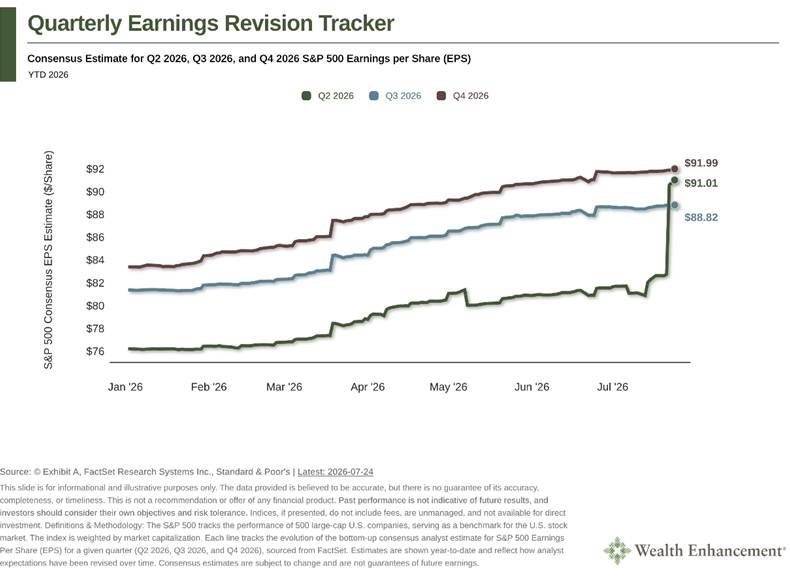
This chart shows the quarterly earnings revision tracker. Consensus EPS estimates for Q2 stand around 91.01, and you can see how sharply they moved higher as reports started to come in, reflecting a very strong quarter for earnings growth among the companies that reported. Q3 is looking to be about 88, and Q4 is around $92, so the outlook remains strong.
Each line reflects how analysts’ expectations for the quarter have evolved since the start of the year, and we are seeing a positive trend. Why does this matter? The direction of earnings revisions has historically offered a window into corporate fundamentals, with rising estimates tending to reflect improving profit expectations and falling estimates often signaling caution.
Estimates are subject to change, of course, as this chart shows. They are certainly not guarantees of future earnings. However, this is important because several of the world’s largest tech companies, including Microsoft, Meta, Apple, and Amazon, are all scheduled to report earnings. Once again, the focus will extend beyond quarterly profits.
Investors will be looking for evidence that AI-related investments are producing measurable business results and that management teams remain disciplined about spending. Spending is the key area to watch, and it is what the market appears to be focused on most.
For investors, last week’s volatility is not, by itself, a signal of a lasting change in the market’s direction. It does, however, reinforce the value of diversification. Technology has led at the top, and when leadership narrows, other sectors, investment styles, and international markets can provide different sources of return.
While rising yields can create short-term pressure in fixed income, they also improve the prospective income available from high-quality bonds, so that is not necessarily negative.
The takeaway is not to react to every headline. It is to recognize that markets are balancing several powerful forces: resilient economic growth, persistent inflation, and geopolitical uncertainty. Behind that is the AI investment cycle, which may be transformative, but still needs to demonstrate attractive returns on the significant capital being invested.
It is exactly the kind of environment in which maintaining a diversified portfolio, staying focused on long-term objectives, and avoiding emotionally driven decisions can be valuable.
We will continue to monitor these developments, keep you updated, and look forward to talking with you during next week’s Weekly Market Update.
Thanks so much.
This information is not intended as a recommendation. The opinions are subject to change at any time and no forecasts can be guaranteed. Investment decisions should always be made based on an investor’s specific circumstances. Investing involves risk, including possible loss of principal.
2026-13392
<a href=”/blog?keyword=&field_category%5B1886%5D=1886” class=”custom-taxonomy-link”>Investing</a>

Insights
Related resources for you
Get the latest wealth management tips and trends from our library of articles and resources.


