
Investing Through Market Volatility

Market Volatility Can Create Compelling Opportunities
When the stock market takes a hit, it’s easy to focus on what’s going wrong. But market downturns can also create compelling opportunities that simply aren’t there when markets are rising.
Market pullbacks can open up attractive entry points for investors who have cash on the sidelines or are thinking about putting new money to work, whether from an inheritance, the sale of a business, a bonus, or another source. The challenge, of course, is knowing how to approach those opportunities without getting caught up in the day-to-day noise.
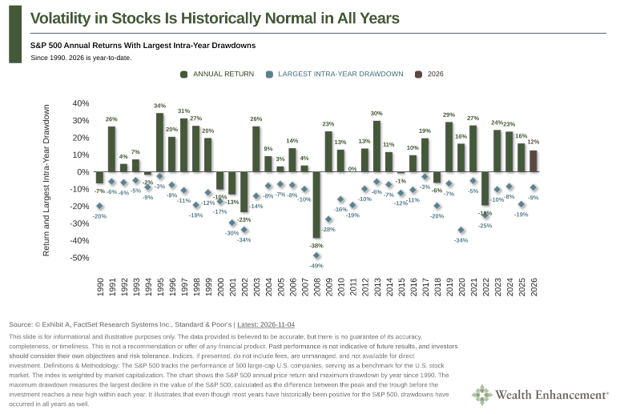
No one can predict exactly where the market is headed next. But history has shown us, time and time again, that volatility is simply part of investing, and some of the most compelling opportunities can emerge during periods of uncertainty. The key is having a plan and knowing how to put it to work.
What’s Behind the Recent Market Swings?
Markets have moved sharply in both directions over the past several days, with technology and semiconductor stocks taking some of the biggest hits. There are a few things driving the uncertainty. Perhaps most obvious is the midterm election outcome. There’s a perception that Democrats will pump the brakes on data center production, not just in Texas, but more broadly, which has rattled a lot of investors. Also, investors are increasingly scrutinizing AI sector regulation, and questioning how quickly the enormous amounts of money being spent on AI and data centers will translate into actual profits. At the same time, in an attempt to manage risk, investors are moving money into more defensive investments that tend to be less sensitive to market movements, like consumer staples, utilities, or healthcare.
There are a lot of moving parts here, and the headlines will likely keep changing. But it’s important to understand that a few rough trading days, or even a few difficult weeks, don’t necessarily change the bigger investment picture. This is not the time to make emotionally driven investment decisions. Market uncertainty is nothing new, and it’s something investors have historically had to navigate through many different economic and market environments.
Putting Cash to Work: What Are Your Options?
If you’ve been sitting on cash, considering investing new money, or waiting for a better entry point, you may be wondering what makes sense in today’s environment. There’s no surefire formula, and trying to predict the perfect day to invest is incredibly difficult. But there are strategic ways to approach a volatile market without feeling like you have to get the timing exactly right.
- Put money to work gradually. Rather than investing everything at once, you can spread investments out over time. This gives you multiple entry points and takes some of the pressure off trying to time the market.
- Consider hedged equity strategies. These strategies are designed to keep you invested in the stock market while providing some cushion against potential losses, often through the use of options. The trade-off is that you may not capture as much of the upside when markets rise abruptly.
- Look beyond traditional stocks and bonds. Low-correlation strategies seek returns from different sources and may behave differently from traditional investments. Adding these strategies to a portfolio can help create more balance and potentially reduce the impact of market swings.
None of these approaches will be right for everyone, and none can eliminate investment risk. But they do offer different ways to thoughtfully put money to work in an uncertain market.
Having a Plan Makes All the Difference
When markets get choppy, having an investment plan becomes extremely valuable. A good investment strategy gives you something to fall back on when headlines turn negative and markets become unpredictable. It helps keep decisions grounded in your goals, your time horizon, and your comfort with risk, rather than what’s happening in the market on any given day.
That doesn’t mean you should ignore opportunities or stick with a strategy that no longer makes sense. In fact, market volatility can be a good reason to revisit your approach, rebalance where it makes sense, or explore different investment strategies. Maybe you have cash you’re thinking about investing, or maybe you’re just wondering if there are other ways to approach the market. Either way, it helps to have a strategy that reflects your goals and gives you a clear path forward.
The goal isn’t to predict every market move. It’s to be prepared to navigate them. If you’re thinking about your next investment decision or just want to talk through your options, we’d be happy to have that conversation.
All investing involves risk, including the possible loss of principal. Hedged equity and other diversifying strategies involve additional risks and may not provide protection during market declines. Diversification does not ensure a profit or protect against loss. This material is for informational purposes only and is not a recommendation to buy or sell any investment.
2026-14778
About the author

Vice President, Portfolio Consulting
CFA®, CFP®
Gary Quinzel is an experienced investment professional with over two decades of expertise in investment strategy, portfolio management, and macroeconomic analysis. Since beginning his career in 2003, he has focused on translating complex market dynamics into clear, actionable…
Related insights


