
Weekly Market Movers | November 2, 2026

 Ayako Yoshioka, Director, Senior Investment Strategist
CFA® ·
Oakwood Team ·
November 2, 2026
·
Today on Weekly Market Movers:
- Markets didn’t hinge on Big Tech. Major indexes were weighed down by losses among the largest tech companies, but many other areas of the market held up well. Small caps, international stocks, energy, and high-quality bonds all helped cushion the decline – highlighting the benefits of diversification.
- Strong earnings couldn’t quiet AI spending scrutiny. More than 80% of S&P 500 companies have beaten estimates, but heavy AI spending weighed on Big Tech companies like Alphabet and Amazon, while Microsoft held up better with strong cloud growth and more disciplined spending. Semiconductor stocks also struggled.
- The Fed paused but isn’t rushing to cut rates. Rates stayed at 3.75%–4%, and because economic growth remains solid and inflation is still elevated, the Fed has little reason to hurry toward rate cuts.
- Oil surged (again) amid Middle East tensions. Brent crude rose nearly 14% in October, adding another potential source of inflation pressure.
- Jobs, earnings, and the midterm elections are the big focus this week. Friday’s jobs report could help shape the Fed’s next move, while another round of major earnings will offer more clues about technology and consumer spending. Tuesday’s midterm elections could also move markets.
Chart of the Week
Transcript
Hello, and welcome to this edition of Weekly Market Movers from Wealth Enhancement. My name is Aya Yoshioka, Director and Senior Investment Strategist.
Well, we kick off the month of November by looking back at the final week and month of October. Fittingly for Halloween, it was a month of tricks for some tech investors and treats for almost everyone else. Well, let’s start with returns across asset classes for the week and month ending October 30.
A sharp tech sell-off on Thursday and Friday pushed the major indices lower for the week. The S&P 500 slipped 0.6%, the Dow fell 0.9%, and the NASDAQ Composite dropped 2% for the week.
While small caps were the bright spot, with the Russell 2000 gaining 1.3%.
Now, for the month of October, the NASDAQ fell 5.3%, its worst month since March 2025, and the S&P 500 was down 0.9%.
The Dow, by contrast, gained 1.7%.
So the bigger story is what is going on underneath the surface of these index-level returns.
The equal-weighted S&P 500, perhaps a better gauge of the average stock, actually rose 4.9% during the month of October, beating the traditional cap-weighted index by the widest margin in a single month since April 2009.
In other words, money didn’t leave the market. It rotated out of the largest tech names and into almost everything else.
And thus, the cap-weighted indices felt a little bit more of the pain.
Now, year to date, the S&P 500 is still up about 11%, small caps are up 13%, and international developed stocks are up about 9%. In commodities, Brent crude rose nearly 14% during the month to around $118 a barrel, its highest level since April, while gold fell roughly 7% to a one-year low.
Now, in fixed income, bonds did their job. The 10-year Treasury fell about seven basis points during the week and by 35 basis points during the month, ending at 4.93% as investors sought safety during the tech-led sell-off in equities.
And the two-year yield, that fell about a quarter of a point to around 4.6%.
So now, what drove all of these moves? Well, last week was the busiest stretch of third-quarter earnings, and fundamentals from all of these earnings reports remain pretty strong. More than 80% of S&P 500 companies that have reported so far have beaten estimates, and earnings are on track to grow nearly 30% from a year ago.
And as a reminder, we started 2026 thinking that S&P 500 earnings growth was gonna only be about 12%.
However, the price reaction from these earnings reports didn’t feel very strong, especially for the mega-cap tech companies.
Now, investors are asking questions about AI once again, and especially focusing on when all of this AI spending is perhaps going to pay off.
Third-quarter earnings from Alphabet, Microsoft, Amazon, and Microsoft showed that revenue growth was really robust, with some reporting growth of nearly 20%.
So revenue growth was not the issue.
Together, these four companies have collectively spent a little over $200,000,000,000 on capital expenditures. This is for data centers and chips and everything that’s needed for the AI infrastructure build-out. And this was roughly $26,000,000,000 more than the cash from operations that came into these companies.
Now, a year ago, they spent within their means, and they had $60,000,000,000 left over.
So the market is really responding to how much these companies are spending and how they continue to spend, and drawing a line between spending that’s paying off and spending that’s going to continue for a little bit longer without seeing that payoff.
Wednesday night, Alphabet reported, and on Thursday, Alphabet fell 12.6%, its worst day since going public in 2004. Google Cloud revenue more than doubled, and search grew 12%, less than expected, but growth nonetheless. So again, growth is not the issue here.
The results did miss expectations, and it was a free cash flow which turned negative by the tune of $9,000,000,000, with even more capital spending planned for 2027, really gave investors a little bit of indigestion.
Now, Microsoft was the relative winner, with the stock down only 1.7% after they reported earnings.
Microsoft reported Azure growing 48% year over year and guided for 50% growth for next quarter.
Additionally, their CapEx was actually lighter than what Wall Street was expecting, leading to positive free cash flow, and investors felt that Microsoft was showing some fiscal discipline.
Now, Amazon’s cloud business accelerated for a sixth straight quarter, which is, you know, really big for a company of its size, but roughly $77,000,000,000 in quarterly CapEx spend pushed free cash flow deeply negative. And despite guidance around AWS, or their cloud business, AWS growth of being closer to 40% over the coming quarters, investors focus on the cost of this growth relative to the level of the growth.
On Friday, the sell-off spread to semiconductors. Intel reported, and that stock fell nearly 29%, its worst day in more than four decades, as a weak fourth-quarter outlook really overshadowed better-than-expected results.
The takeaway from all these earnings: AI demand is real, it’s very robust, but investors are no longer handing out free passes. They are rewarding spending that comes with profit growth and penalizing spending that’s simply burning cash.
Outside of earnings, the Fed held rates steady at 3.75% to 4%, in line with market expectations, even though they had just raised rates by a quarter point last September.
The Fed actually paused because they want some more data. They did describe the economy as being strong and inflation as elevated. And we see that in the numbers. Third-quarter GDP actually grew at a 3.4% pace, and core PCE inflation, the Fed’s preferred inflation gauge, is running at 3.1%.
Now, heading into their next meeting on December 8 and 9, risks still remain that the Fed is likely to hike rather than cut. This recent pause was just that, a pause, not a pivot.
Now, geopolitics also kept energy markets on edge, and the conflict in the Middle East continues to pressure energy prices, and we saw oil hit a six-month high.
Higher energy prices feed into inflation and rate expectations, so the prolonged duration of this conflict weighs on our capacity for future economic growth.
Now, looking ahead, let’s look at some charts.
And from a market perspective, or equity market perspective, we are actually entering a seasonally strong period for markets.
Now, November, we typically see, on average, returns of 1.85%, and in December, returns of 1.39%.
From an earnings standpoint, as we look ahead, Apple and Palantir report on Monday, and AMD reports Tuesday, an important read on whether chip demand can hold up after last week. Qualcomm and ARM Holdings will also add some more color on the overall semiconductor market, while McDonald’s, Uber, and Airbnb will give us a pulse on the consumer.
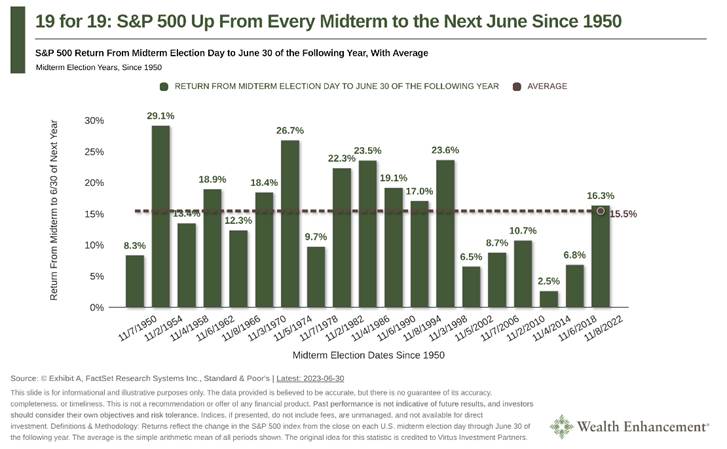
Now, I would be remiss if I didn’t mention that Tuesday, November 3, brings the U.S. midterm elections, which could shape fiscal policy and the path of the overall Iran conflict. Now, going back to the last 19 midterm elections, the returns from Election Day until June 30 of the following year have all been positive, 19 for ‘19, with an average return of 15.5%.
Pretty strong numbers. We hope this continues in 2026 and into 2027.
But looking out into the week, another headliner is Friday’s jobs report number. Economists are expecting roughly 55,000 to 65,000 new jobs, up from the 29,000 jobs reported in September.
And expectations are that the unemployment rate remains steady at 4.2%.
A soft report would challenge the case for a December rate hike, while a strong report with hot wage growth would really reinforce it.
That sets up the October CPI report on November 10, and we’ll be looking to see how hot that might be.
Now, the bottom line, October was a reminder of why diversification really matters and why we’ve talked about index concentration for so long.
Even as the largest tech companies and tech stocks pulled back, the average stock, energy, high-quality bonds, and other areas of the market cushioned portfolios.
Well, that’s all I have for this week. Thank you so much for watching the Weekly Market Movers videos from Wealth Enhancement.
This information is not intended as a recommendation. The opinions are subject to change at any time and no forecasts can be guaranteed. Investment decisions should always be made based on an investor’s specific circumstances. Investing involves risk, including possible loss of principal.
2026-14679
About the author
Director, Senior Investment Strategist
CFA®
Over the course of her career in the investment and wealth management industry, Ayako has built extensive experience across portfolio management, investment research and client relations. She began her career in Institutional Client Relations and Marketing before becoming a…
Related insights


