
Weekly Market Movers | November 6, 2026

Today on Weekly Market Movers:
- Tech and AI Took the Brunt of the Selloff: The Nasdaq fell nearly 5% as investors questioned whether massive AI spending and current stock prices can be justified.
- The Election Added a New Wrinkle for AI: Proposed limits on new data centers in Texas, which accounts for roughly 30% of planned U.S. data center capacity, raised new questions about the pace of the AI buildout.
- AI’s Reach Goes Well Beyond Tech Stocks: The boom now touches corporate debt, power demand, construction, data centers, and other parts of the economy, making any slowdown potentially much broader than tech alone.
- The Swings May Not Be Over: Market volatility jumped sharply, and automated trading appears to have accelerated some of the recent selling.
- The Economy Is Sending a Much Calmer Message: Today’s jobs report showed that the U.S. added 166,000 jobs in October, unemployment fell to 4.1%, and hiring improved across industries, suggesting the market turmoil is not being driven by a weakening economy.
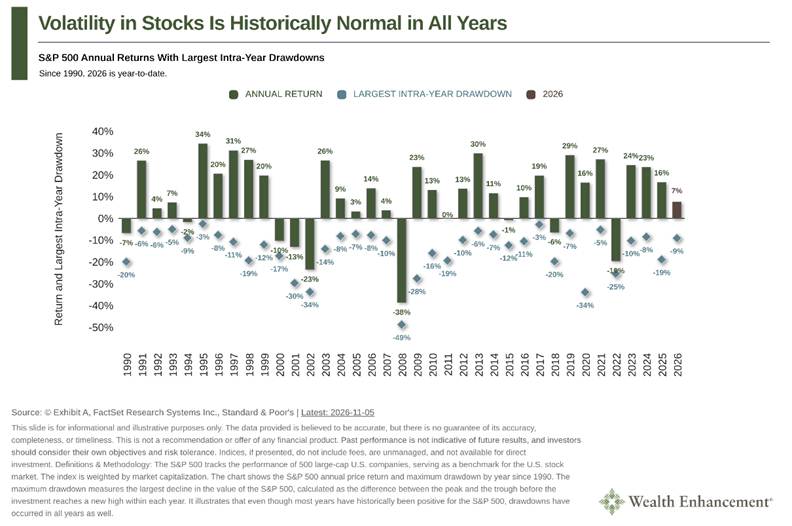
- Keep the Selloff in Perspective: Sharp pullbacks are a normal part of investing. In fact, historical data suggests that even periods with the largest intra-year drawdowns have produced positive average full-year returns. The big message here is to stay diversified and avoid making long-term decisions based on a few volatile days, or even weeks.
Chart of the Week
Transcript
Hello everyone. Welcome to the Weekly Market Movers. My name is Gary Quinzel, Vice President of Portfolio Consulting at Wealth Enhancement. We are coming to you a little bit earlier this week due to all of the recent activity related to the AI and tech sell-off, as well as the midterm elections. So, as of midday on Friday, we’ve seen the Dow down just a little bit, minus 0.6%; S&P 500 down around 2%; Nasdaq 100, the tech-heavy index, down almost 5%; and the 10-year yield down around seven basis points, which means bonds are slightly higher.
Now, that might not sound like a lot, but how we got there is a different story because we’ve seen quite a bit of up and down since the events that started last week. And as my colleague, Aya Yoshioka, talked about last week, it was a big week for mega-cap earnings last week, and that actually led up into a fairly notable tech sell-off on Friday. And I know I had talked about that a lot, particularly related to firms like Microsoft and Amazon, Alphabet, a lot of the hyperscalers, leading up to semiconductor stocks on Friday, such as Intel, that saw its biggest one-day decline in many decades. It really did continue to kind of reinforce the theme around AI skepticism about all the spending that’s occurring and whether or not the ROI, the return on investment, is going to validate the elevated price increases that we’ve seen over the last few years. And so, what happened last week, it began with first the Fed, of course, holding rates steady, as we all know by now, and then we did see that stronger-than-expected earnings results. At the same time, we saw some forward guidance that looked a little more skeptical, and it was a little more cautious.
That was particularly the case for Intel, and we saw that across many other names as well. So, let’s fast-forward into this week, because it was a whole different story when we finally had the long-anticipated midterm elections, which, of course, happened on this past Tuesday. Well, I’m not sure if anyone heavily anticipated what we saw. We knew that there was a fairly good probability of a Democratic sweep. I’m not sure most people anticipated it would be as significant or as decisive as it eventually was. And so, what happened with that is, at first, the initial reaction on Wednesday was actually struck a positive tone in the sense that markets were effectively relieved that the, that kind of overcast of uncertainty was gone, and we saw a pretty much broad-based rally across the markets on Wednesday.
Of course, that all came to a stop on Thursday, when we saw quite a reversal related to AI and technology names. And so, why exactly did that happen? Well, again, it kind of reinforces some of the concerns that we talked about last week about the realization of earnings and forward guidance as it relates to the current valuations that have been built up for all these big tech names. But probably even more specific, one of the major concerns that we’ve observed is related to increased scrutiny around some of the big buildups related to data centers, particularly in states where we’ve seen just really notable buildup in construction, particularly Texas. And that’s an easy one to call out because of the fact that Texas now has its first Democratic governor in many, many decades. They elected a Democratic senator as well, hasn’t happened for a long time, and the governor in particular has already announced that she will announce a moratorium on new data center buildups.
Now, why does that matter? Well, Texas really has been at the epicenter of the data center buildout. If you take a look at their in-process construction pipeline, they’re roughly double the second-largest state, which is Virginia, and they actually currently account for roughly 30% of the planned U.S. data center capacity, making it the single largest concentration of at-risk supply fueling this AI buildup. And so, clearly, when we got past the outcome uncertainty of the election, now the results are starting to crystallize, and investors are starting to wonder, what does this mean on a go-forward basis?
What does this mean for the continued buildup of this trade that is so heavily dependent upon data centers, upon the hyperscalers spending so much?
All of that is potentially in flux right now, and investors are starting to question about the sustainability. And obviously, we’ve been in this trade for quite some time. I think there’s some really interesting facts to consider when we think about how far we’ve come in such a short amount of time. It feels like such a long time ago, but it was really only about three, four years ago, late 2022, when ChatGPT was first announced. Since that point, $32,000,000,000,000 in market value has been created or added to the S&P 500 Index.
And if you take that another level, more than half of that market capitalization came out of just 10 companies, all of which are linked in some fashion to artificial intelligence, certainly names like Nvidia being a big part of that. And it’s not just stocks where AI’s economic importance is purely related to, because growth overall in the economy has been related to spending on technology firms, and, of course, on the bond market as well. The U.S. corporate bond market is on track for its busiest year ever, due in large part to all of the investment-grade bonds that are being issued related to the buildout of AI infrastructure. In fact, technology corporate bonds are now the largest portion of the IG sector outside of financials. Financials continue to make up the biggest section of that.
And so, here we are. We are now at a point where, you know, there’s a lot of uncertainty out there, and we expect volatility to remain elevated in the near term for a few reasons. One, nothing has really been resolved yet related to what’s gonna happen next in terms of the AI data center buildout. I think it’s gonna take some time for that to materialize, but probably more importantly, just the concept around conditional volatility. And what we know about volatility is that it tends to stay low for extended periods of time, but when it does become elevated, and we saw the VIX shoot up, the VIX is the CBOE Volatility Index, we saw it shoot up over 50%, and when it does do those kind of larger moves than normal, we tend to see it be autocorrelated, which means volatility that goes high will end up staying high. And that concept we expect to continue in the near future as uncertainty prevails in the market.
So, something that we’re certainly going to keep a close eye on, and that has lots of considerations, just as we think about ways that risk managers are pricing risk.
Another important component as we think about what happened over the last couple days, just the concept around systematic traders, because what we’ve identified and observed thus far in the early kind of days of the market sell-off that started on Thursday is that it was clear that, looking at E-mini futures market, the S&P 500, Nasdaq, that systematic and programmatic trading were largely large contributors to the sell-off, and we saw that a lot of those technical triggers, particularly on the Nasdaq, were tripped, which led to that kind of escalated fast money moving. So, thinking CTA traders, hedge fund traders, all played a large part in the escalated sell-off, and once those things start to happen, we’ve seen them kind of continue in the short run.
So, as long as market valuations kind of remain at the elevated level, we know volatility is remaining high due to that autocorrelation of volatility. We expect that we could see more volatility no matter what happens on Friday. And Friday, we did see some leveling off of certain markets, even though overnight Asian markets were down, Europe markets were down, but not as down as far as U.S., and we saw some steadying off. But the key takeaway here is that we do believe we’re at a period where we should expect more uncertainty in the near term and volatility to prevail.
But on the positive side of things, from an economic standpoint, we’ve noted that, or I should call out the fact that we did have September payrolls, which were quite positive, quite strong. In fact, it was the strongest number in several months. We saw 166,000 jobs being added, which topped all forecasts in a broad advance across many sectors, everything from business, professional services, healthcare, manufacturing. Overall, the private sector growth was the strongest it’s been since March, and also we saw the unemployment rate dip lower to around 4.1%.
And that’s incredibly notable because through September 2026, the U.S. labor market has been, the unemployment rate has been below 5% for 61 straight months, which is just three months shy of the record 64-month streak, which dates all the way back to 1965 to 1970. So, the bottom line there is that we are on the verge of having the longest stretch of sustained labor market growth, minus that period, almost five decades ago. So, overall, we continue to have a very strong labor market, which is certainly a positive. It means the underlying economy remains strong, albeit supported largely by the AI tailwind and strong consumer spending. But we do have positive growth in the economy, particularly related to GDP, consumer spending, healthy labor market, and though rates are higher than we were used to them being, and as I mentioned at the start of this call, the Fed did keep rates steady, overall, we have not seen strong evidence that it has been prohibitive of overall business activity.
And so, with that, I’m gonna wrap things up today. A lot more to come. We expect more updates to materialize over the coming days, and we look forward to bringing these to you as you think about how to make smart portfolio decisions. But I think the key takeaway that I’m gonna share with you, as I share this chart here, that doesn’t wanna share right away, is that market volatility is quite normal. And so, we’ve shared this chart at different times, and the message really stands throughout the test of time. It’s annual returns of the S&P 500, going all the way back to 1990, and also showing the intra-year drawdowns.
It’s just another reminder that pullbacks are normal. They’re a part of a normal market cycle. They shouldn’t be overly concerned about. If anything, take advantage of them to the extent you can. If you have idle cash, you can put it to work. You can invest in hedged equity strategies or low-correlation strategies if you’re a little uncertain about the market. And if you have questions about either of those two things, just reach out to your financial advisor at Wealth Enhancement. We’d be happy to walk you through that. So, if you have any questions, reach out. We’ll continue to keep you updated as things materialize, and thanks a bunch for listening today.
This information is not intended as a recommendation. The opinions are subject to change at any time and no forecasts can be guaranteed. Investment decisions should always be made based on an investor’s specific circumstances. Investing involves risk, including possible loss of principal.
2026-14781
About the author

Vice President, Portfolio Consulting
CFA®, CFP®
Gary Quinzel is an experienced investment professional with over two decades of expertise in investment strategy, portfolio management, and macroeconomic analysis. Since beginning his career in 2003, he has focused on translating complex market dynamics into clear, actionable…
Related insights


