
Weekly Market Movers | November 23, 2026

Today on Weekly Market Movers:
- Markets Swung Hard, Then Reversed: The S&P 500 fell 8.6% last week, but stocks bounced back sharply Monday as some of the fear around tech and AI eased.
- Jensen Huang’s Return Changed the Mood: Nvidia fell nearly 23% last week despite exceptional earnings, then surged Monday following news that Huang would return as CEO.shg
- AI Spending Is Being Repriced: Demand hasn’t disappeared, but investors are taking a harder look at valuations, financing, and how long the massive AI buildout can continue.
- Bonds Helped Balance the Selloff: Treasury prices rose as stocks, gold, copper, and Bitcoin fell, providing some stability during a turbulent week.
- The Economy Has Slowed, Not Stopped: Retail sales and industrial production softened, but low unemployment claims and other data don’t point to a broad recession.
- Inflation Is Still Above Target: Wednesday’s PCE report is expected to show core inflation around 3.2%, keeping the possibility of another Fed rate increase in play.
- Thanksgiving Could Magnify Market Swings: Markets are closed Thursday and close early Friday, and lighter holiday trading can make price moves more pronounced.
Chart of the Week
Transcript
Hello, and welcome to this edition of Weekly Market Movers from Wealth Enhancement. My name is Aya Yoshioka, Director and Senior Investment Strategist, and boy, are markets really moving.
Last week, equities moved lower, but this was not a routine pullback. It was a rapid repricing of AI-related stocks and AI-related growth, and it has been a very tough November so far, but the speed and the move really picked up last week. However, news of Jensen Huang’s return to NVIDIA as CEO have now reversed a good portion of this downside momentum, and equity markets are up substantially to start this shortened Thanksgiving week. Last week, the S&P 500 fell 8.6%, its worst weekly decline in more than 18 months, and the index entered correction territory.
The Dow lost 8%, the Nasdaq declined 10%, and the Russell 2000 fell about 7.5%. Friday alone accounted for a large portion of those losses, with the S&P 500 down 3.7% and the Nasdaq down 5.3%. However, it looks like we’re getting a very big reversal on Monday, November 23.
The selling was very broad last week, but it was not evenly distributed. Tech was the weakest sector, while consumer staples held up the best. Fewer than 60 companies actually advanced within the S&P 500, and the VIX, or the Volatility Index, rose from 19 to nearly 36.
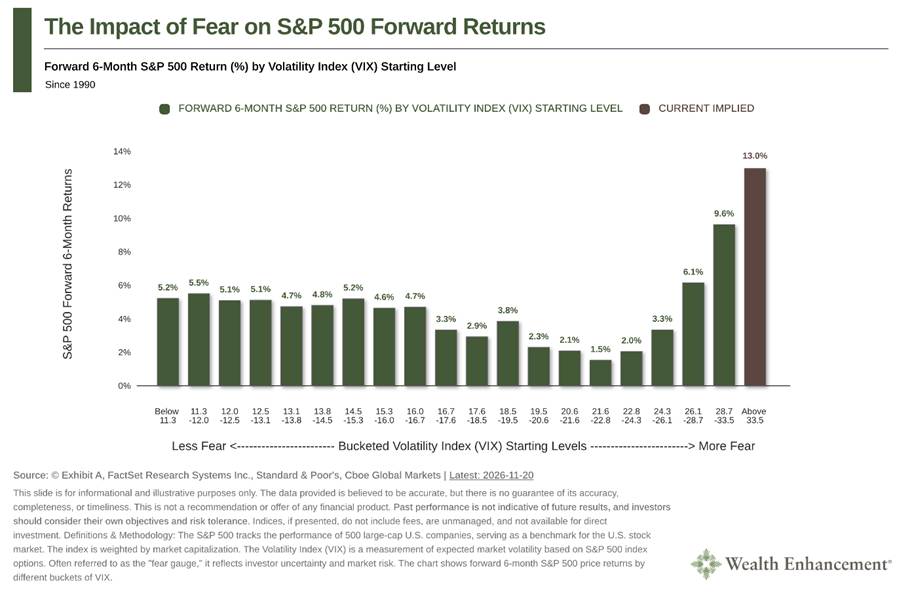
Now, of the VIX, I’d like to share a quick chart here.
This chart shows forward returns for the S&P 500, forward six-month returns at different levels of the VIX. And as you can see, when the VIX is above 33.5, as it currently was at the end of last week, the six-month implied return is 13%.
I would also note that next year, 2027, is the third year in a presidential election year, a four-year presidential cycle, and average returns during that third year are around 17%.
However, regardless of all of these stats, investors reduced risk last week across equities and commodities, and they demanded a larger margin of safety. And some of this is getting reversed today.
NVIDIA last week reported extraordinary operating results. Quarterly revenue reached $115,800,000,000, more than double the level from a year ago, and data center revenue increased 110%. The company also forecasts approximately $130,000,000,000 of revenue for the upcoming quarter and expects to grow revenue for the fiscal year by 75% for the full year, up from 70%, which was the guidance given last quarter.
Yet NVIDIA shares last week fell almost 23%.
Strong results were not enough to offset concerns about the management transition, customer financing, and the durability of the AI capital spending, as NVIDIA has been a central player in the innovation, financing, and the overall buildout of AI.
And perhaps because of all of this, news of Jensen’s return has catapulted shares on Monday, with the stock up over 30% just today.
Other big news from last week, well, we had a high-profile IPO from Anthropic, symbol ANT, which also failed to catalyze or stabilize overall sentiment in equity markets. The offering raised $81,300,000,000, topping SpaceX’s $75,000,000,000 raise, and it became the biggest IPO by proceeds on record, and it priced ANT at $1,500,000,000,000 in market cap. Despite all this fanfare, the stock closed 6% above its $83 IPO price after two days of trading on Friday.
All right, let me stop sharing here.
Now, in other news, last week, we also had minutes from the Federal Reserve’s October meeting, which showed that inflation remains elevated and that policymakers continue to lean toward additional tightening.
Two members preferred an immediate quarter-point increase in October, and investors are assigning a high probability to another increase in December.
Ordinarily, this message would push Treasury yields higher.
But last week, the opposite occurred as demand for safety took priority. The two-year Treasury yield ended near 4.63%, roughly 25 basis points lower for the week. The 10-year yield declined about 23 basis points to 4.92%, and the 30-year yield fell roughly 16 basis points to 5.31%. That rally in Treasuries is important. High-quality bonds provided ballast while stocks, gold, copper, and Bitcoin all declined. It also suggests that part of the market’s concern shifted from inflation or inflation alone towards concerns about growth, concerns about liquidity, and the possibility that tighter financial conditions could reinforce the equity sell-off.
Lastly, when zooming out and taking a look at the overall U.S. economy, the data we got last week paints a picture that remains mixed rather than one that was clearly recessionary.
October retail sales last week told us that retail sales increased only two-tenths of 1%, but sales excluding autos and gasoline rose a firmer five-tenths of 1%. Industrial production declined four-tenths of 1%, and housing starts rebounded almost 10%, yet building permits fell more than 7%, which raises the question about whether the improvement in construction can continue.
Weekly unemployment claims remained at 203,000, and taken all together, the data shows slower momentum in certain areas, but not the broad deterioration in employment and overall economic activity that usually defines a recession.
Last week’s market move was primarily a repricing of expectations and crowded positioning, not confirmation that the economy has suddenly contracted.
All right, well, turning to a shortened week ahead, this week is shortened by the Thanksgiving holiday. And on the earnings front, we’ll get news from Dell and HP, which report on Tuesday. Their results will matter beyond the personal computing market. Investors will be focusing on enterprise tech budgets and overall spending on AI, AI server demand and component costs, and whether or not hardware companies can protect their margins as the AI investment cycle becomes more selective.
Wednesday brings a lot of economic data before we actually get to enjoy our turkeys. We’ll get the second estimate of third-quarter GDP, durable goods orders, jobless claims, and new home sales data. The Federal Reserve will also be publishing its Beige Book, which summarizes business conditions across the country. The central report on Wednesday will be the October Personal Consumption Expenditures Price Index, or PCE, the Fed’s preferred inflation measure.
Core inflation, excluding food and energy, is expected to be up 3.2% versus last year. And last month, it was around that 3.1% level, so slightly elevated this month, at least in terms of expectation.
If it’s anywhere close to these estimates, it will mark the 67th consecutive month with a reading above the Fed’s 2% target.
U.S. markets are closed on Thursday for the Thanksgiving holiday, and they close early at 1 p.m. Eastern on Friday. Trading volumes are often lighter around this Thanksgiving holiday week, so price movements can be exaggerated when fewer investors are active in markets.
It’s impossible to know how long this volatility in markets will persist, but market volatility can bring important portfolio and planning decisions to the forefront, and our financial advisors are available to support and plan for this inevitable volatility. It can also provide opportunities to invest available cash on the sidelines, review portfolios for appropriate positioning, and identify potential tax-loss harvesting opportunities.
Thank you for listening, and I hope you all have a wonderful Thanksgiving.
This information is not intended as a recommendation. The opinions are subject to change at any time and no forecasts can be guaranteed. Investment decisions should always be made based on an investor’s specific circumstances. Investing involves risk, including possible loss of principal.
2026-15003
About the author

Director, Senior Investment Strategist
CFA®
Over the course of her career in the investment and wealth management industry, Ayako has built extensive experience across portfolio management, investment research and client relations. She began her career in Institutional Client Relations and Marketing before becoming a…
Related insights


