
Weekly Market Movers | November 16, 2026

Today on Weekly Market Movers:
- Stocks Bounced Back Broadly: The S&P 500, Nasdaq, and Dow all gained, with strength extending well beyond the biggest tech companies.
- Nvidia Was the Big Exception: Shares fell about 13% after CEO Jensen Huang stepped down, showing how much leadership can matter when one company carries so much weight in the market.
- AI Winners Are Starting to Separate: AMD, Broadcom, and CoreWeave gained as investors looked beyond AI excitement to leadership, financing, execution, and actual business results.
- Inflation Pushed Rates Higher: Consumer prices came in hotter than expected, sending Treasury yields sharply higher and keeping borrowing costs elevated.
- Housing Is Stuck: Existing home sales fell to their lowest level since 2010 as high prices and mortgage rates continued to squeeze buyers.
- Consumers Get a Checkup This Week: Retail sales and earnings from Walmart, Target, Home Depot, Lowe’s, Disney, and others should show how households are handling higher prices.
- A Huge Week for AI: Nvidia reports earnings, while Anthropic is expected to price its IPO, giving investors two very different looks at demand for AI investments.
- The Long View Still Matters: Markets regularly hit rough patches, but history shows why reacting to every headline can work against long-term investors.
Chart of the Week
Transcript
Good morning, and welcome to Wealth Enhancement’s weekly Market Movers video series. My name is Doug Huber, and I’m the chief investment officer here at Wealth Enhancement. Really looking forward to getting into what’s driving the markets this week. We’re going to touch on what went on last week and what we’re watching going forward, and so let’s get into it.
Last week, I think, was interesting. It brought a relatively broad rebound in stocks, but it also delivered one of the sharpest increases in U.S. Treasury yields this year. And so I think this contrast is quite interesting, and we’ll dive into that a little bit.
On the equity side, the S&P 500 gained about 2.5%, the tech-heavy NASDAQ rose slightly less at about 2.3%, and the Dow Jones Industrial Average was up roughly 2%. From a sector side, energy actually led the way, up about 5%, but we also saw a strong performance out of industrials, communication services, and technology, each up about 3%. I think what’s more interesting is this wasn’t just a story of, like, the few huge mega-cap tech companies pulling that index upward.
It actually was quite broad-based, and if anything, one of the biggest tech names did quite the opposite. And so that obviously was Nvidia. Major exception to last week’s move. Its stock fell roughly 13%, I want to say, after their chief executive officer, Jensen Huang, resigned both as CEO and board member. Chief financial officer Colette Kress became the interim CEO while the board’s beginning a search for a permanent successor.
I think part of this is just market construct, because Nvidia represents 7% of the S&P 500, the cap-weighted index, the one we all look at on a day-to-day basis. Its decline actually had a really large impact on the index, much more than similar moves of smaller companies would have. And so if you actually stripped out Nvidia last week, the S&P 500 would have been up almost 4%. So really quite an impact when you have these sharp moves with the highest, the largest companies because they represent just a bigger piece of the index.
On the flip side, though, other AI-related companies performed quite differently. AMD and Broadcom each gained, I think, over 15% last week, I think on the back of the Nvidia news and that there might be greater competition in that chip sector. So they were kind of the beneficiaries of Nvidia’s decline.
Another big one that jumped last week, and I think was a positive for the AI kind of story in general, was a business called CoreWeave. That has been a company that has really been the poster child of kind of angst from the stock market and the credit markets. They actually, you know, the bonds that they have borrowed on were trading down at junk levels. There was a lot of concern around the viability of this business on a go-forward basis, but they came out and reported a great quarter.
I think $3.7 billion of revenue, backlog of $132 billion, and so that was a good sign, I think, to the markets on just where the AI trade is. The message here is not so much that AI demand is accelerating or disappearing. I think as the market is continuing to figure out how to price the AI paradigm that we’re in, it’s ascribing, I think, a little bit more value to leadership. You’re seeing that with the key-person risk of a highly successful CEO of these businesses moving on is having quite an impact in Nvidia.
I think that same thought process is going through analysts’ heads as they look at other businesses that are very dependent upon a key person. So I think leadership is being priced into these stocks a little bit more. Obviously, financing and execution continues to be the story a little bit more than just, wow, AI, and look at the scale of this opportunity. The market is continuing to figure out how to be more selective about who’s going to win there.
On the economic side, a couple of big prints last week. Consumer prices came out. I think they were up four-tenths of 1% in October. That was one-tenth more than expected, so a hot read.
Core inflation rose three-tenths, also above forecast and really driven by shelter, food, medical care, and insurance. Those are really the biggest contributors. A little bit on the flip side, a little bit inverse to the consumer side, the producer price side was somewhat better on a monthly basis. It was up three-tenths versus four-tenths expected, so it came in a little lighter, but the annual producer price rate reached 6.5%.
That inflation message is not reassuring here, and I think you’re seeing the market really trying to tell the Fed that they are aware, right? The other big one to look at: housing. I think that’s the one showing the biggest kind of impact of higher rates, right? Existing home sales fell 5.5% to, I think, an annualized pace of roughly 3.75 million. That’s the lowest since 2010. And so you’re seeing inventories increase, prices continue to either stay stable or go up in most markets, but nobody’s buying because it’s just become not affordable, whether that’s on the price side or on the lending side, that your mortgage rate is just so much higher you can’t afford as much house. So there’s really kind of a, the housing industry’s kind of stuck in it at the moment, and so we’ll be watching that quite closely.
With all that, you saw the Treasury market respond relatively forcefully, right? The two-year yield rose to about 4.88%, the 10-year, I think, backed up in the neighborhood of 15 or 20 basis points to 5.15%, and the 30-year finished just under 5.5% at 5.47%.
And I think if you break that down, what caused that increase in the 10-year yield, it really came from what we call real yields. And that’s just saying investors are demanding more inflation-adjusted compensation rather than just simply pricing a large increase of that long-term inflation. So, I need to get paid more for this, is what they’re telling people. And I think that distinction matters because if you look across on the corporate credit side, investment-grade and high-yield credit spreads actually tightened last week. And I think it’s interesting in that we live in this world where you have an economy that continues to do relatively well in the background.
I think corporations are well situated, both in terms of future earnings but in terms of their capital stacks, their balance sheets.
But on the flip side, inflation continues to be kind of a nagging force that we’d like to see some resolution to. There still continues to be a lot of focus on the AI theme, right? Because that’s really, I think, what we’re all kind of now participating in, is the future prospects that are driven by artificial intelligence. And so that brings us to this week, two really important tests in the market this week.
First is Nvidia does report earnings on Tuesday. This is going to be a highly followed call. Analysts are expecting, I think, almost $110 billion, $109 billion of revenue, adjusted earnings of somewhere around $2.47 a share.
Those numbers, I think, are less important for the quarter, right? The conference call is what’s going to matter. Investors want clarity on the customer commitments, China, product execution, financing arrangements, and most importantly, some confidence around who’s going to lead this company. How has Jensen’s exit changed the story, if at all?
And they’re going to want that delivered in a way that is pretty resounding. I think any lack of clarity will continue to have the market really kind of look a little bit more closely at the Nvidia investment. The other big one, Anthropic, the makers of Claude, which I’m sure a lot of people use, is expected to price its initial public offering on Wednesday, potentially begin trading, I think, as early as Thursday. So with the proposed range of $70 to $78 a share, it’s going to be one of the largest IPOs ever, probably right in line or right behind SpaceX that we had earlier this year.
I think strong demand for that IPO would confirm that investors still want that AI exposure. It may not lift every tech stock, however, because a lot of times institutions that might want to buy the IPO have to sell something to buy it. So you could see some rotation inside of tech, but I think a weaker or delayed deal for any reasons might raise broader questions about private market valuations on these businesses and financing that’s available for these AI infrastructure plays. Keep an eye on both the Nvidia call as well as the Anthropic IPO.
We’ll come back to you next week with some readouts on what we saw and heard from that. Economic calendar this week, I think retail sales is going to be a big one.
It’ll be between retail sales and the fact that we’re getting some consumer earnings reports out of Home Depot, Disney, Target, Lowe’s, TJX, Walmart. This is going to be a week that’s really going to give the market a lot of clarity into how is the consumer doing with these elevated levels of inflation, and so that will be important to watch.
I will get some details out of the Federal Reserve on their October decision, and then we’ll see some Treasuries price later in the week, both the 20-year bonds and some 10-year TIPS. I think demand’s going to really matter in these auctions because higher real yields affect other things, right? Your mortgage, business investment, valuation of long-duration growth companies. This is something, the rates on Treasuries have broad impact across the financial markets. So it’s something to really keep an eye on and think about where are other areas, where is that circularly built into portfolios. I think the balanced takeaway here is that stocks really had broad resilience last week.
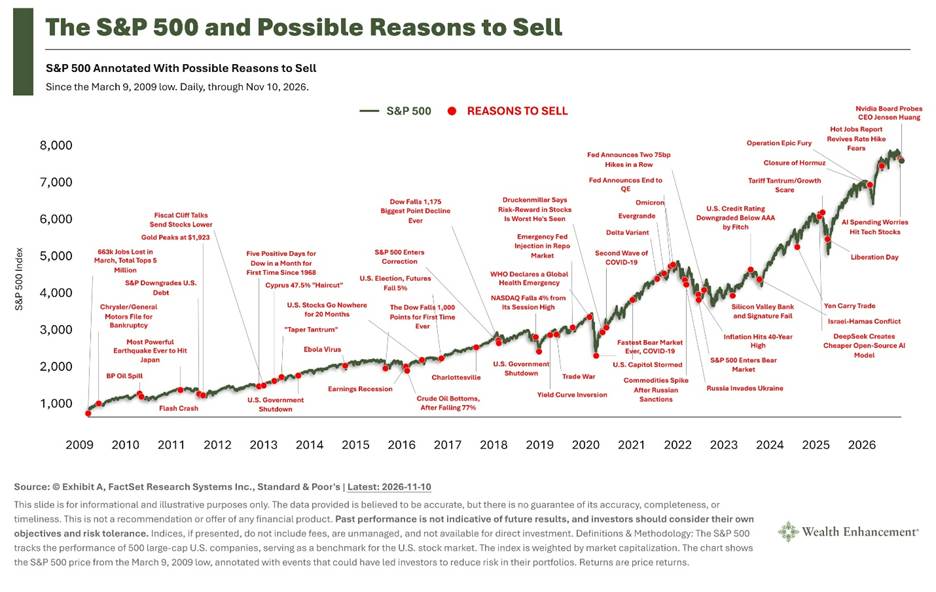
A little bit of pressure on rate-sensitive assets. Credit remained orderly, but there’s still a lot of crosscurrents going on. I think to wrap things up, we talk about this a lot, this idea of staying invested, this idea of building durable, diversified portfolios to make sure you can keep that discipline, and I think this is an interesting chart I just wanted to share because I think it’s a good one. I’ve seen it in a lot of different forms, but there’s always a reason to get out and sell. These news headlines, they’re concerning.
This just goes back to ‘09. Somebody put this together. I mean, I’m sure there’s 10,000 little lines we could put on here, and I’m not going to point to any one particular, right? But I think the fact of the matter is, as you can see over long periods of time, the market tends to compound in your favor.
Now there’s going to be short periods of blips. You can see it in 2020 with COVID, you can see it in 2022 as rates rose, you can see it last year with tariff tantrum. You see it earlier this year when we began the conflict in Iran. I mean, heck, if you brought this way back, you’d see ‘08 and you’d see 2000 with the tech crash.
But the fact of the matter is the market continues to move on. It’s going to price on a lot of different things, and so just keep what you’re hearing in mind.
It doesn’t mean it’s not important, but what it does mean is it’s important to figure out where the impact is, but what else is out there? What are other things that are continuing to drive the economy onward and upward? So with that, I’ll wrap up this week. We look forward to coming back to you next week. It’s going to be a shortened week because of Thanksgiving, but we’ll do have a lot to talk about, especially with Nvidia’s earnings, with the consumer earnings this week, and then the Anthropic IPO. So thanks for tuning in this week. We’ll talk soon.
This information is not intended as a recommendation. The opinions are subject to change at any time and no forecasts can be guaranteed. Investment decisions should always be made based on an investor’s specific circumstances. Investing involves risk, including possible loss of principal.
2026-14876
About the author

Chief Investment Officer
Doug Huber brings 19 years of financial services experience to his current role of Chief Investment Officer at Wealth Enhancement. In his role, he is responsible for driving the investment process for portfolios managed by Wealth Enhancement Advisory Services (WEAS), leading…
Related insights


